

Every tablet that leaves a press carries a promise: the right dose, in the right form, every time. A tablet defect breaks that promise. Some defects are cosmetic and only hurt brand perception. Others mean the tablet will not disintegrate correctly, will not deliver the intended dose, or carries contamination. In a product where the end user is a patient, a defective tablet is never just a wasted unit.
This guide covers the full picture. What tablet defects actually are, the most common defect types and what causes them, why the cost of a defect depends almost entirely on when you catch it, and how computer vision has moved tablet inspection from a fraction of the batch to every single tablet at production speed.
What counts as a tablet defect
A tablet defect is any deviation from the approved specification for appearance, dimensions, integrity, or performance. In practice, manufacturers split defects into two families, and the split matters because the two families are caught in different ways.
Cosmetic (visual) defects
Capping, lamination, chipping, cracking, sticking, picking, colour variation, coating faults, print faults, and surface contamination. These are what the eye, and increasingly the camera, can see.
Functional defects
Weight and content uniformity, hardness, friability, and dissolution. These determine whether the tablet performs as designed, and they are usually measured by instruments rather than by sight.
Tablets remain the most widely used oral dosage form because they are cheap to make, stable, and easy for patients to take. That volume is exactly why cosmetic defects matter so much. Even a defect rate of a fraction of a percent becomes a large, countable number of tablets across a full batch, and a large number of decisions about whether that batch can be released.
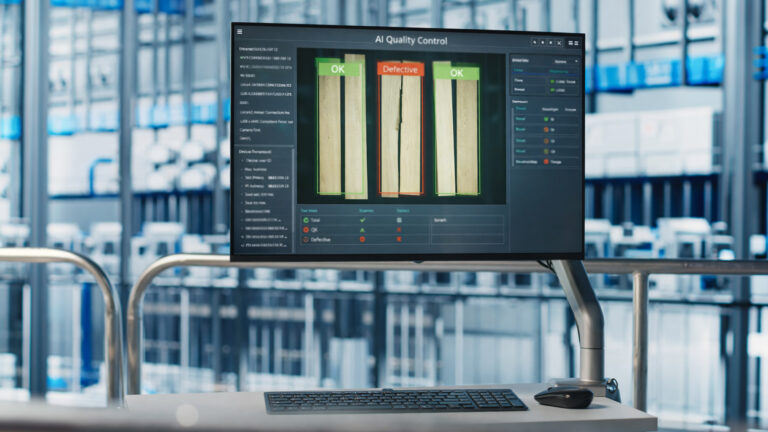
Most defects announce themselves on the surface. That is why visual inspection has always sat inside tablet quality control. Computer vision takes the same inspection job and runs it on 100% of production instead of a sample. We cover computer vision for quality control in more detail separately, but the short version is: cameras do not blink, tire, or disagree with each other.
Why tablet defects matter more than they look
The cost of a tablet defect is not the cost of the tablet. It is the cost of everything that happens once a defective tablet is harder to find, or found later. Four forces make this a board-level issue in pharmaceutical manufacturing.
Patient safety
A cracked or capped tablet does not guarantee a dose. A tablet with foreign specks can carry a contaminant. In the worst cases, defects are a patient safety event rather than a quality metric. Every quality decision on a tablet line is ultimately a patient decision, and regulators treat it that way.
Regulatory pressure and recalls
The FDA’s FY2024 Report on the State of Pharmaceutical Quality recorded 421 recalled products across 260 recall events from 165 sites. Recall events rose roughly 15% versus FY2023 even as the number of recalled products reached a five-year low. Recalls related to CGMP deficiencies accounted for about 24% of recalls, down from roughly 50% across FY2020 to FY2023. Contamination remains the most cited defect group.
Drug shortages
Quality problems do not only trigger recalls. They interrupt supply. The FDA’s work on drug shortages has repeatedly linked shortages to manufacturing and product quality problems. The 2019 Drug Shortages Task Force found that 62% of drugs entering shortage between 2013 and 2017 were associated with manufacturing or product quality problems, including quality defects in the finished product. When a line stops to investigate a defect, the shortage risk is real.
The clock starts the moment a defect reaches a distributed product. Under FDA’s Field Alert Report rules and 21 CFR 314.81(b)(1), applicants must notify the FDA within three working days of learning that a distributed batch may fail to meet specification. Early detection is not only cheaper. It is the difference between a contained deviation and a field action.
The one rule that changes the economics: detect early
The financial impact of a defect scales with how far it travels down the line. A defect caught at incoming inspection costs almost nothing, because the material can be rejected before it enters production. The same defect caught after release can exceed a million dollars once a recall, regulatory correspondence, and lost market trust are counted.
$100k
all-in cost of one deviation
A lost batch runs $250,000 to $500,000. Investigation labour alone reached about $14,000 per incident by 2023.
Figures collected in a public benchmark round-up of deviation costs. The wider cost of poor quality is put at 15 to 20% of sales revenue in many organisations.
That is the case for 100% inspection in one sentence: the cheapest defect is the one you catch before the tablet is coated, packed, or shipped. For a wider view of the cost model, see our breakdown of when computer vision ROI is highest in manufacturing.
The complete guide to tablet defects
The tables below cover the defects you will meet on a tableting line, grouped by where they come from. For each, the important thing is the mechanism, because the mechanism tells you whether the fix is in the formulation, the tooling, the press settings, or the inspection layer. The descriptions follow standard pharmaceutical references on tablet defect causes and remedies and an open-access review of tablet manufacturing defects.
Compression and mechanical defects
| Defect | What it looks like | Main mechanism |
|---|---|---|
| Capping | The face of the tablet separates and comes away as a cap | Air trapped in the granule, elastic recovery as the tablet leaves the die |
| Lamination | The tablet splits into layers, sometimes internally | Air entrapment plus die-wall shear stress at ejection |
| Chipping | Edges break or chip off | Worn punches and dies, over-dry granules, rough handling |
| Cracking | Fine cracks on the surface or band | Excessive compression force, elastic recovery, brittle formulation |
| Sticking | Granule adheres to the die wall, leaving a torn surface | Moisture, low lubrication, abrasive material |
| Picking | Pits where material was pulled from the surface | Adhesion to the punch face, worst on engraved tooling |
| Binding | Tablets stick within the die during compression | High ejection forces, die wear, excess moisture |
| Double impression | A faint or doubled logo or score line | A loose or mis-set punch |
| Edge erosion | Rounded or dusty edges after handling | High friability, mechanical handling |
Lamination is the hardest of these to catch by eye, because the split can sit below the surface. Its mechanisms are set out in this open-access study of lamination in pharmaceutical tablets.
Coating defects
| Defect | What it looks like | Main mechanism |
|---|---|---|
| Coating cracks and peeling | The film fractures or lifts away from the core | Brittle film, poor spray and drying, mismatched elasticity |
| Blistering | Pockets form under the film | Trapped moisture or solvent released during drying |
| Colour variation | Patchy or uneven colour | Uneven spray, low suspension solids, short batches |
| Bridging | Film fills across a logo or score line | Over-coating, poor tablet shape |
| Dark or black spots | Localised dark marks on the surface | Long coating times, abrasive pigments, pan wear |
Print, marking, contamination and dimensional defects
Print and marking. Missing, faded, misaligned, or wrong prints are their own defect class, because the marking on a tablet is often how a patient or a pharmacist identifies the drug and the strength. For high-potency or look-alike products, a print defect can be mistaken for a different medicine, which is why misidentification is explicitly named in the FAR reporting criteria.
Contamination and foreign matter. Specks, hairs, metal fragments, and mixed tablets from a previous run. Contamination is the most cited recall driver in the FDA quality data, and it is a pure detection problem: the defect is visible, and the cost of missing it is the highest of any category.
Dimensional and weight. Thickness, weight, and hardness variation. Some are visible (clearly the wrong size or shape), while weight and hardness require measurement. A vision system flags obvious dimensional outliers and mixed tablets; dedicated instruments handle the analytical side.
How tablet defects are caught today, and where it breaks
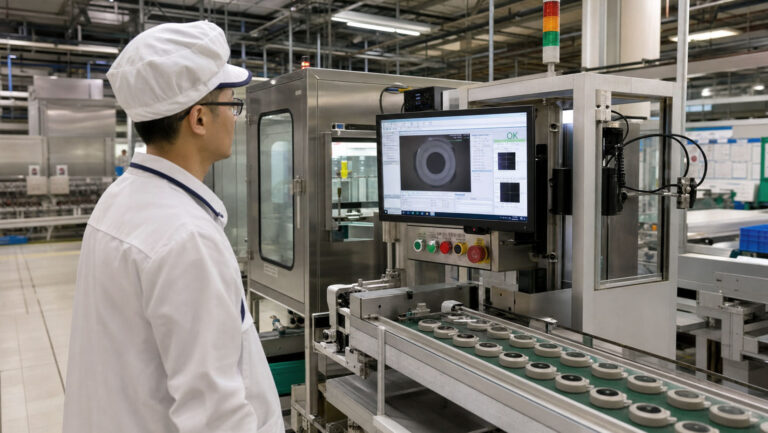
Automated inspection combines several imaging types to cover the whole tablet: colour cameras for surface appearance and print, 3D laser or structured light for topography (chips, capping, engraving depth), and backlighting where the product allows it. Rotary tables and multi-camera stations image top, bottom, edge, and sidewall for 360 degree coverage, and defective units are sorted out individually instead of rejecting an entire pack. The question shifts from “how many tablets can we afford to check” to “what defect criteria do we define, and how do we validate them.” We looked at the human side in depth in our article on AI quality control and the path to 99% defect detection.
What computer vision can, and cannot, detect on a tablet
Overselling automation helps no one. Here is an honest map of what surface-based computer vision handles well, and where a different technology is required.
| Defect class | Detectable? | How, and the caveat |
|---|---|---|
| Surface chips, cracks, edge damage | Yes | 2D colour plus 3D topography; features down to tens of microns with the right optics. |
| Coating faults, colour variation, spots | Yes | Colour cameras and calibrated lighting; needs stable illumination to separate defect from reflection. |
| Print, emboss and engraving integrity | Yes | Optical character recognition and verification, with 3D for engraving depth. |
| Foreign matter on the surface | Yes | Visible particles only. Particulates inside a coating or core need other methods. |
| Mixed, missing, or wrong tablets | Yes | Shape and colour classification against a known reference. |
| Capping and lamination before they surface | Limited | 3D profiling catches raised caps; internal cracks need x-ray or CT. |
| Coating thickness, sub-surface structure | No | Requires optical coherence tomography, near-infrared, or spectroscopy. |
| Weight and content uniformity | No | Measured by checkweighing and analytical testing, not by sight. |
The honest conclusion: computer vision gives you complete, consistent coverage of the visible surface, which is where the majority of cosmetic defects live. For internal integrity and analytical attributes, pair it with the right complementary technology rather than expecting one system to do everything. See how this plays out across imaging types in our comparison of RGB, x-ray, and hyperspectral imaging.
How a computer vision tablet inspection system works
Under the marketing, every automated inspection system runs the same pipeline. Understanding it makes vendor evaluation far easier.
Feed and singulate
Tablets are separated into a stable, repeatable presentation, typically on a rotating cylinder or a slat track, so each unit is imaged from a known position.
Image
Multiple stations capture top, bottom, edge, and sidewall views. Colour, 3D, and backlight images are combined into a complete picture of each tablet.
Analyse
A model classifies each unit and computes measurements against the defect criteria defined for that product.
Decide and sort
Defective units are rejected individually and the rejection is verified; good units pass through untouched.
Record
Every decision is logged, so the inspection can be reviewed, audited, and improved.
What GMP requires of an inspection system
In a regulated environment, a tablet inspection system is not just a camera. It is part of the quality system. Four requirements decide whether a working system becomes a deployable one.
This is the part that separates a demonstration from a deployable system, and it is where a manufacturer should apply pressure in a vendor evaluation. A model that works on a test set is the beginning of the work, not the end of it.
Where computer vision pays for itself
The business case rests on three effects, and only the first is about the camera.
Where this lands financially depends on your defect rate, your batch value, and how far a defect currently travels before it is found. We cover the economics in more detail in our analysis of real results and ROI from AI quality control, and in the broader roundup of computer vision projects running in production today.
Agmis and tablet inspection
Agmis designs and builds computer vision inspection systems for manufacturers. Our work sits squarely in the industrial quality control space, and the architecture we use on those lines is the one this article describes: robust imaging, a model trained on your parts and your defect examples, unit-level rejection, and a data trail.
We have pushed surface inspection accuracy into the high nineties on materials far less uniform than a tablet, including surface quality inspection of furniture board. A tablet has a controlled geometry, a known colour, and stable lighting. From an imaging standpoint, that is a friendlier problem. Applied to oral solid dose, the approach targets exactly the defect classes that surface inspection handles well: chips, cracks, capping and lamination that show on the surface, coating and colour faults, print integrity, foreign matter, and mixed tablets.
We will also be straight about the boundaries. Pharmaceutical inspection carries validation and documentation obligations that a generic industrial project does not, and we design for them from the start rather than bolting them on. The same discipline applies anywhere a defect is a safety event rather than a quality metric, which is why we also work on patient-safety-critical problems such as computer vision in healthcare.
If you manufacture tablets and want to know whether a specific defect on your line is catchable, the fastest path is a short conversation and a few sample images. We would rather tell you honestly where computer vision fits and where it does not than sell you a system that overpromises.
Get a clear path forward.
Share your challenge and walk away with concrete next steps - whether you're exploring AI, automating a process, or scoping a custom software project.
- Honest assessment of your situation - no sales pitch
- Actionable next steps you can use right away
- AI, automation, and custom software expertise