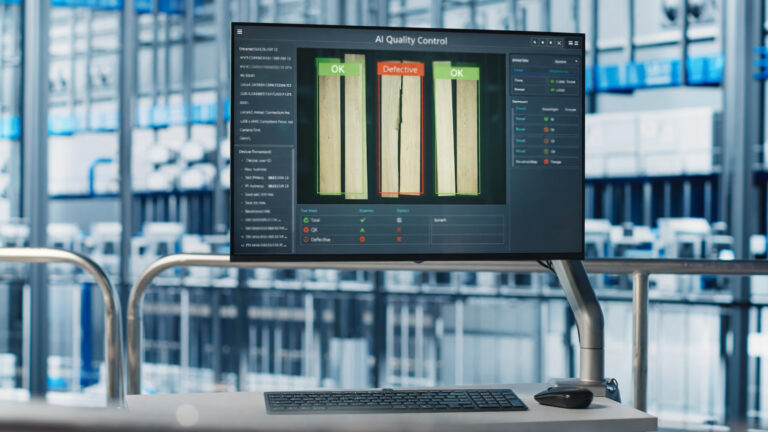


A frozen food manufacturer has a contamination problem. Plastic fragments are ending up in finished products. They install an RGB camera system with AI defect detection – and it catches nothing. The plastic is clear, the same color as the product, and sometimes even the same texture. The $50,000 system is useless for the one problem they actually needed to solve.
This scenario plays out constantly in food manufacturing. AI vision systems are marketed as universal solutions, but the reality is that different inspection technologies detect fundamentally different types of defects. Choosing the wrong one means spending money on a system that misses your most critical quality issues.
Food contamination affects almost 1 in 9 people globally each year, according to the World Health Organization, causing an estimated 600 million illnesses and 420,000 deaths annually. The average direct cost of a single food recall in the U.S. was estimated at $10 million in 2024 – not including brand damage and lost sales.
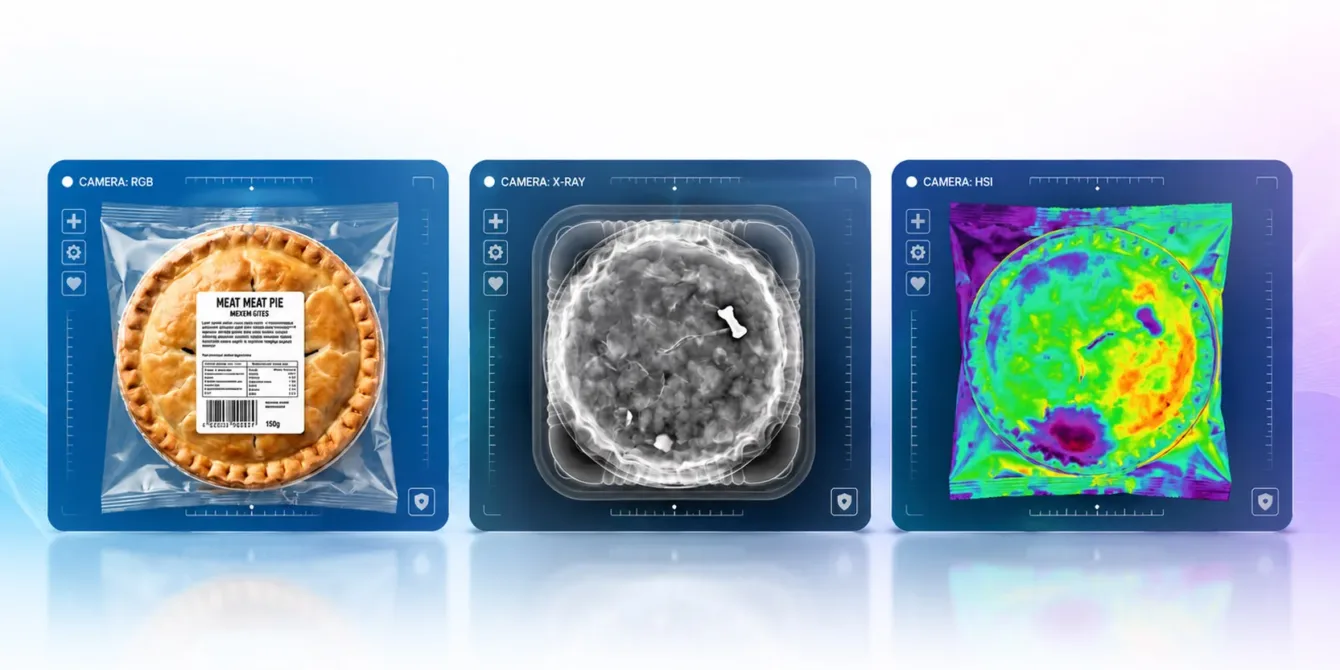
This guide breaks down the three main AI vision technologies for food quality control – RGB cameras, X-ray systems, and hyperspectral imaging – with a practical framework for choosing the right technology (or combination) for your specific production challenge.
1. RGB Cameras – Surface Inspection
How it works: High-resolution industrial cameras capture visible light (red, green, blue – the same spectrum the human eye sees). AI models – typically Convolutional Neural Networks such as YOLO or ResNet – analyze each frame in milliseconds, classifying individual products as pass or reject. These systems are the most mature and widely deployed AI vision technology in food processing.
What it detects:
- Color defects: browning, discoloration, uneven ripening
- Shape and size anomalies: misshapen products, broken pieces, foreign objects with distinct appearance
- Surface texture defects: bruises, cuts, lesions, freezer burn
- Packaging integrity: seal checks, label placement, tamper evidence
- OCR and label verification: expiry dates, lot codes, allergen declarations
Limitations:
- Cannot see inside products – surface defects only
- Misses contaminants that match the product’s color or texture (clear plastic in white rice, dark insects in chocolate)
- Cannot detect chemical contamination, microbial spoilage, or allergen traces
- Sensitive to lighting conditions; requires consistent illumination across the inspection area
Best for: Color grading (fruit ripeness, meat freshness), shape sorting, label and expiry date verification, packaging seal inspection. Production lines where surface quality is the primary concern and contaminants are visually distinct. The same modality logic decides surface inspection of tablets, where colour and 3D imaging cover the visible surface but internal cracks still need another method.
Real-world reference: AutomationWorld reports that Oxipital AI’s V-CortX platform uses 3D scans of real food products to generate millions of synthetic training examples automatically, enabling AI inspection without manual image annotation – achieving detection speeds that keep pace with high-volume production lines.
2. X-ray Systems – Internal Structure
How it works: X-rays penetrate the product. Denser materials (metal, glass, bone) absorb more radiation and appear as dark regions on the detector. AI models analyze the resulting grayscale images for anomalies that indicate contamination or structural defects.
Traditional X-ray systems operate at 1-2 energy levels. Next-generation hyperspectral X-ray systems – such as Xnext’s XSpectra – analyze up to 1,024 X-ray energy levels, enabling detection of low-density contaminants that conventional X-ray systems miss entirely, including certain plastics, wood, and insect fragments.
What it detects:
- Dense foreign objects: metal fragments, glass shards, calcified bones, stones
- Internal voids and holes, particularly in closed bakery products and sealed packages
- Fill level discrepancies in pre-packaged goods
- Product density anomalies that may indicate spoilage, pest damage, or processing errors
Limitations:
- Cannot characterize chemical or nutritive properties (fat content, moisture, protein)
- Misses contaminants with density similar to the product (plastic polymers in bread, certain insects in grain)
- Higher equipment cost – industrial X-ray inspection systems typically range from $50,000 to $200,000+
- Limited to density-based detection; a product could be structurally intact but chemically spoiled, and X-ray would not flag it
Best for: Detection of metal, glass, and bone fragments. Fill-level verification in sealed packages. Inspection of dense, uniform products where internal contaminants are the primary food safety risk.
Regulatory note
The FDA’s FSMA 204 traceability rule, with a compliance deadline of July 2028, requires enhanced recordkeeping for foods on the Food Traceability List. AI-powered X-ray inspection systems that log detection data per batch are increasingly used to fulfill these traceability requirements, creating a digital chain of custody that manual inspection cannot provide.
3. Hyperspectral Imaging – Chemical Fingerprinting
How it works: Where an RGB camera captures 3 wavelength bands (red, green, blue) per pixel, hyperspectral cameras capture dozens or hundreds of narrow wavelength bands across the visible and near-infrared (NIR) spectrum – typically ranging from 400 nm to 2,500 nm. Every material has a unique spectral “fingerprint” – a chemical barcode that AI models can be trained to recognize.
This means hyperspectral imaging can detect contaminants and quality attributes that are completely invisible to both RGB cameras and X-ray systems. Each pixel in the image contains the complete spectral signature of the material at that point, enabling material identification rather than just visual detection. Agmis has applied this technology in custom multi-sensor systems for food production lines across Europe.
What it detects:
- Chemical composition: fat content, moisture, sugar, protein, salt levels – in real time
- Microbial spoilage: spectral signatures of bacterial growth before any visible signs appear
- Allergen traces: cross-contamination from peanuts, dairy, gluten, soy – invisible to other sensors
- Foreign materials: plastics, wood, insects, and other contaminants that differ chemically from the product
- Adulteration: undeclared fillers, mislabeled species (fish fraud, olive oil authenticity, honey adulteration)
- Ripeness and maturity: chlorophyll breakdown, sugar accumulation, starch conversion
Limitations:
- Cannot see through products (unlike X-ray) – hyperspectral is surface and near-surface only
- Higher cost: $30,000-80,000+ per camera depending on spectral range and resolution
- Significant data processing requirements – each image is a data cube containing spectral information across all wavelengths
- Requires calibration per product type – spectral signatures vary across different food matrices
Best for: Quality grading by chemical composition (fat/moisture/protein ratios in meat, BRIX in fruit), allergen cross-contamination detection, early spoilage detection, authenticity testing. Production lines where invisible quality attributes determine product value and safety.
4. Head-to-Head Comparison
| Capability | RGB Camera | X-ray System | Hyperspectral |
|---|---|---|---|
| Surface defects | ✓ Excellent | ✗ Cannot see | ✓ Good (with surface chemistry) |
| Internal contaminants | ✗ Cannot see | ✓ Excellent (dense objects) | ✗ Surface only |
| Chemical composition | ✗ Cannot detect | ✗ Cannot detect | ✓ Excellent |
| Microbial spoilage | ✗ After visible only | ✗ Cannot detect | ✓ Before visible signs |
| Allergen detection | ✗ Cannot detect | ✗ Cannot detect | ✓ Good |
| Packaging / label QC | ✓ Excellent | ~ Fill level only | ✗ Not suitable |
| Throughput | >1,200 units/min | >800 units/min | 100-300 units/min |
| Relative cost | $ Low | $$$ High | $$$$ Highest |
| Technology maturity | Highly mature | Mature | Emerging |
Throughput and cost ranges are approximate and depend on configuration.
5. Decision Framework
Use this matrix to identify the right starting technology for your specific quality challenge:
| If Your Primary Problem Is… | Start With | Consider Adding |
|---|---|---|
| Visible surface defects (color, shape, bruises, blemishes) | RGB camera + CNN | Hyperspectral if chemical quality also matters |
| Metal, glass, or bone contamination | X-ray inspection | Hyperspectral X-ray for low-density contaminants |
| Chemical quality (fat%, moisture, protein, sugar) | Hyperspectral NIR | RGB for simultaneous surface inspection |
| Microbial spoilage detection | Hyperspectral imaging | RGB and X-ray cannot detect this |
| Allergen cross-contamination | Hyperspectral imaging | Requires chemical detection – RGB and X-ray cannot help here |
| Packaging and label verification | RGB + OCR | X-ray for sealed-package fill level |
| Plastics, wood, or low-density contaminants | Hyperspectral X-ray | Hyperspectral NIR for chemical confirmation |
| Full-spectrum quality (appearance + chemistry + internal) | Multi-sensor fusion | Data integration platform to combine alerts |
The “one camera fits all” myth
Most food manufacturers want a single inspection solution that does everything. Reality is that no single sensor technology can detect all defect types. A multi-sensor data fusion approach combines RGB for surface defects, X-ray for internal contaminants, and hyperspectral for chemical issues – each handling what it does best, with an AI platform fusing the data streams into a single pass/fail decision per unit.
6. The Hidden Problem: False Positives
Every technology comparison focuses on detection accuracy – and the numbers are impressive. Industry research shows that deep learning models for food quality assessment achieve accuracy rates of 95-99% across a wide range of applications. Human visual inspection averages significantly lower accuracy, with performance degrading over extended inspection periods.
But almost no one talks about false positive rates.
A false positive is when the system rejects a good product. At production line speeds of 300-1,200 units per minute – typical for high-volume food processing – even a 1% false positive rate means rejecting 3-12 good products per minute. Over an 8-hour shift, that’s 1,440-5,760 units of perfectly good product wasted. For high-value items – steak cuts, artisan cheese, organic produce – this cost can dwarf the savings from catching actual defects.
This is why sensor choice matters so much. An RGB system looking for chemical contamination will generate massive false positive rates because it simply cannot see what matters. A properly matched sensor technology – or combination of sensors – minimizes false positives by only looking for what each sensor is designed to detect. Managing false positive rates is one of the key challenges for industrial adoption of computer vision systems in food production, and it requires proper sensor-to-defect matching from the start.
7. The Multi-Sensor Future
The most effective food inspection systems combine multiple sensor types in a data fusion architecture. Rather than relying on a single technology, these systems use each sensor for what it does best:
RGB
Surface defects, color grading, packaging verification
X-RAY
Dense contaminants, fill levels, internal voids
HSI
Chemical composition, spoilage, allergens, adulteration
An AI platform – typically a decision-level fusion model – receives inputs from all three sensors and makes a single pass/reject decision per product unit. Agmis builds these integrated AI platforms for manufacturers across Europe. This approach achieves what no single sensor can: complete quality coverage from surface appearance to internal structure to chemical composition.
The FDA’s FSMA 204 traceability rule is accelerating adoption of these integrated systems because they provide digital records at every inspection point – creating a verifiable chain of custody that manual inspection and paper-based systems cannot match.
8. Building the Business Case
The ROI calculation for AI food inspection systems depends heavily on matching the right sensor technology to the actual defect profile of your production line. Based on current industry data:
Labor replacement
Manual inspectors cost $30-50/hour at ~85% accuracy. A single AI vision system can replace 2-4 inspectors per shift, with a typical payback period of 12-18 months.
Recall prevention
The average recall costs $10 million. Even one prevented recall justifies the investment in a multi-sensor system.
Waste reduction
Properly tuned AI systems reduce false reject waste by 30-50% compared to threshold-based machine vision systems.
Throughput
AI vision systems inspect every unit at full line speed – something human inspectors cannot sustain for more than 20-30 minutes at peak accuracy.
Compliance
Digital inspection logs satisfy FSMA 204 traceability requirements, reducing audit preparation time and compliance risk.
Key insight
The most common mistake in food AI QC projects is selecting the sensor technology before thoroughly characterizing the defect profile. A manufacturer with metal contamination needs X-ray, not hyperspectral. A dairy producer tracking spoilage needs hyperspectral, not X-ray. Always start with the defect, not the technology. For a deeper look at real-world implementation data, read our detailed analysis on AI quality control in food manufacturing: real results and ROI.
9. Key Takeaways
Before you invest in any AI food inspection system
01
Start with the defect, not the technology. Your contamination profile determines which sensor is right – not the other way around.
02
No single sensor covers everything. RGB for surfaces, X-ray for internal density, hyperspectral for chemistry. Multi-sensor fusion is the only path to complete coverage.
03
False positives are the hidden cost. A poorly matched sensor can waste more good product than it saves. Match the sensor to the defect to minimize false rejects.
04
Regulatory pressure is accelerating adoption. FSMA 204 traceability requirements make digital inspection logs a compliance necessity, not an optional upgrade.
05
ROI is real – but only with the right fit. Properly matched AI inspection systems pay for themselves in 12-18 months through labor savings, recall prevention, and waste reduction.
10. How Agmis Can Help
At Agmis, we build custom AI vision solutions for manufacturing quality control. Our team has hands-on experience with RGB, X-ray, and hyperspectral imaging systems – and as an independent AI vision integrator, we provide technology-agnostic recommendations tailored to your specific production challenges, not a product from a limited portfolio.
Our expertise includes:
GrainODM
AI-powered grain quality inspection, recognised as AI Innovation of the Year 2025
ScanWatch
Computer vision for retail loss prevention and self-checkout accuracy
Custom multi-sensor systems
Combining hyperspectral imaging for early spoilage detection with RGB cameras for packaging integrity – creating a unified quality gateway for food production lines across Europe
As we’ve emphasised throughout this guide, the most common mistake is selecting a sensor technology before thoroughly characterising the defect profile. Our discovery workshop process begins with exactly that: understanding your specific quality challenges before recommending any technology. Because the right answer starts with the right question.
We don’t just build and deploy – we partner with you for continuous model refinement, ensuring your quality control processes remain cutting-edge, compliant, and cost-effective as your production evolves.