Your Best Inspector Misses 1 in 7 Defects. Not because they’re careless. Because they’re human.
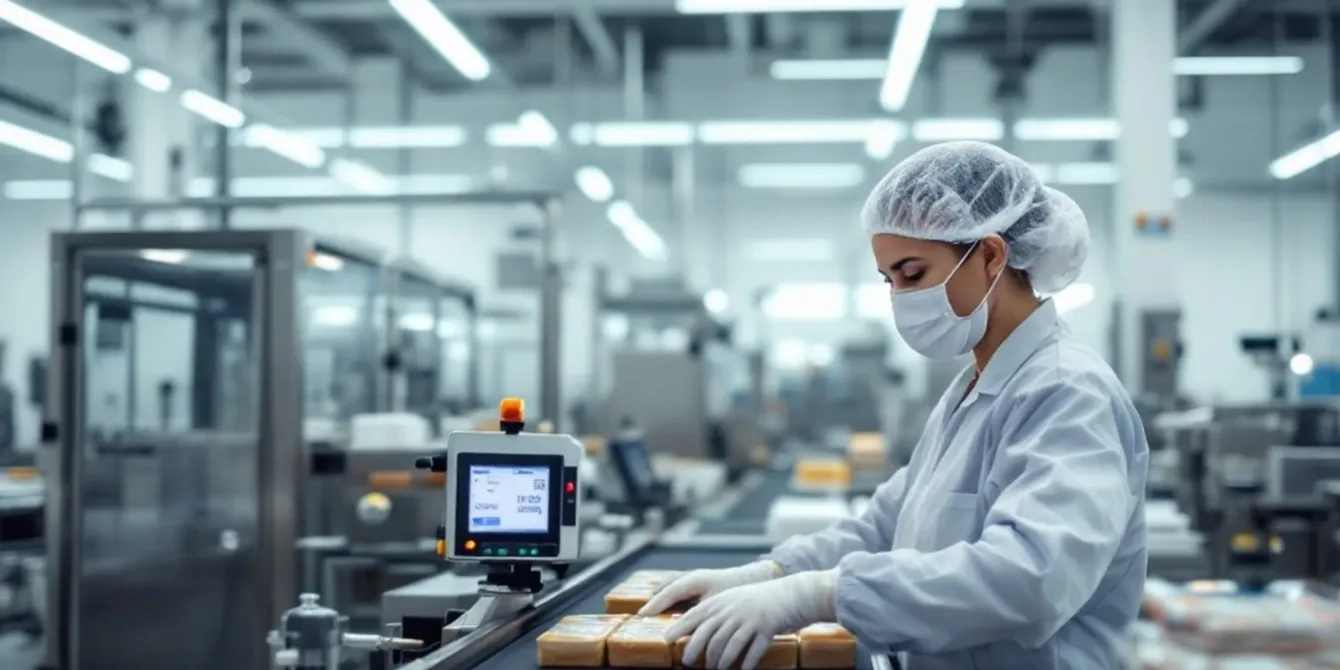
After four hours on a high-speed food production line, even the most experienced quality control specialist starts to fatigue. Their eyes blur. Their attention drifts. Somewhere between unit 847 and unit 848, a defect slips through. The 600 million people sickened and 420,000 deaths from contaminated food each year are, in part, a failure of inspection – not of intent or effort, but of the fundamental limits of human attention at production speed.
Manual inspection at production speed misses roughly 1 in 7 defects – a figure that has held consistent across multiple industry studies. A human inspector processing 200-400 units per minute with 2-3 seconds per evaluation is fighting biology – and biology always wins.
The global AI market in food safety and quality control was estimated at $2.7 billion in 2024 and is projected to reach $13.7 billion by 2030 – growing at a compound annual growth rate of 30.9%. The drivers: rising foodborne illness outbreaks, complex global supply chains, recalls averaging $10 million or more per incident (including direct costs and brand damage), and technology that has finally reached industrial-grade reliability.
This guide covers what AI-powered food quality control actually looks like in production – the technologies that work, the results that are verifiable, and a practical path to implementation.
Why Manual Inspection Is Failing
Here’s the uncomfortable truth: human inspection is the weakest link on high-speed production lines. Not because inspectors are careless – because they’re human.
The problem gets worse as the shift goes on. Research in ergonomics shows that inspection accuracy can degrade by 20-30% after just one hour of continuous monitoring. The last hour of a shift is the most dangerous – and it’s when the most defects slip through.
What this looks like at scale
A typical production line running 10,000 units per day with a 2% defect rate and 85% human detection accuracy ships roughly 30 defective products every day. Over a year, that’s nearly 11,000 defective units reaching consumers.
Each one is a potential safety incident.
This isn’t a training problem. It’s a design problem. As we’ve explored in our comprehensive guide to AI quality control in manufacturing, improving human inspection yields rapidly diminishing returns. Adding a second inspector improves detection by maybe 5-10%. Adding a third adds cost without proportional quality gains. You’re fighting biology with headcount.
How AI Is Transforming Food Quality Control
AI-powered quality control removes the biological limitations from the equation. An AI inspection system processes every unit with identical attention – whether it’s the first unit of the morning or the ten-thousandth unit of a triple shift. Modern AI systems achieve 99%+ detection accuracy consistently, classify 50+ defect categories simultaneously (vs. 5-10 for human inspectors), and operate at speeds of 3,000+ units per minute.
The technology stack typically combines:
CV
Computer vision
High-speed cameras capturing RGB, hyperspectral, and X-ray imagery simultaneously
DL
Deep learning models
Convolutional neural networks trained on millions of labeled food images, classifying defects in under 10ms per frame
EC
Edge computing
On-device inference that eliminates cloud latency and keeps data on-premises for compliance
AR
Automated rejection systems
Pneumatic or robotic mechanisms that remove defective units in real time
Recent academic research confirms that computer vision technologies integrated with deep learning have significantly improved food inspection accuracy, enabling real-time defect detection, ripeness estimation, and contamination identification that was previously impossible at production speed.
Addressing the Skeptic
Food quality managers who evaluate AI systems raise legitimate concerns. Here are the ones we hear most often – and how they’re addressed in production deployments.
“Won’t AI generate too many false positives and waste good product?”
This is the most common objection – and it’s a valid one. Aggressive AI models can indeed reject acceptable product if sensitivity is set too high. The solution is configurable sensitivity thresholds. Modern AI inspection systems allow quality teams to set different thresholds for different defect categories: high sensitivity for critical safety defects (metal, glass, pathogens), calibrated thresholds for cosmetic defects. In practice, this means AI systems reduce both false negatives (missed defects) and false positives (wasted good product) compared to manual inspection – precisely because they can be tuned per defect category, which human inspectors cannot.
“How does AI learn to distinguish a real defect from natural product variation?”
Natural food products have inherent variability – a slightly darker potato chip, a differently shaped cookie, a seasonal color shift in fruit. AI models handle this through diverse, representative training datasets that capture the full range of acceptable variation. The model is trained to recognize “normal variance” as acceptable, while flagging genuine defects that fall outside that distribution. This is a fundamentally different approach from fixed-threshold machine vision, which can’t adapt to natural variability.
“Does AI replace my inspectors?”
In practice, AI doesn’t replace human inspectors – it elevates their role. The AI handles 100% inline inspection at production speed, catching the obvious defects and flagging ambiguous cases for human review. Your inspectors shift from monotonous visual screening – where accuracy degrades over hours – to exception handling, calibration, and process improvement. The result: higher job satisfaction, better use of human judgment, and dramatically lower defect escape rates.
“How much data do we need to get started?”
The data requirement varies by complexity. Simple surface inspection (color grading, shape sorting) can achieve 95%+ accuracy with a few hundred labeled images. Complex multi-defect systems detecting foreign objects, chemical contamination, and packaging faults typically require a few thousands or tens of thousands. The good news: models improve continuously. The system you deploy on day one with 95% accuracy will reach 99%+ within months as it learns from production data.
The practical path: Most manufacturers start with a proof-of-concept on one line, using their existing defect logs and a few weeks of production images to train the initial model. Once the model proves out, the infrastructure scales to additional lines.
Three Sensor Technologies, Three Capability Layers
Modern AI food inspection isn’t one technology – it’s a layered system. Each sensor type covers a different category of defects:
Layer 01
RGB Cameras
Surface-level inspection – color grading, shape sorting, label verification, packaging seal checks.
Best for: visible defects. Low cost, fast, highly accurate.
Layer 02
X-Ray Systems
Sees inside the product – metal fragments, glass shards, bone pieces, internal voids. Next-generation systems analyze 1,024 energy levels vs. traditional 1-2.
Best for: embedded foreign objects invisible to RGB cameras.
Layer 03
Hyperspectral Imaging
Detects what’s invisible to both RGB and X-ray – chemical composition, microbial spoilage, moisture content, fat/protein ratios, allergen traces. Each pixel carries a full spectral fingerprint.
Best for: quality analysis at the molecular level.
No single sensor covers all defect types. The best AI inspection systems use multi-sensor data fusion, combining inputs from multiple technologies for comprehensive coverage. Each of these technology options comes with different tradeoffs. A custom computer vision system can be tuned to your specific products and defect types but requires more upfront investment. A platform like TOMRA is proven at massive scale but locks you into their hardware ecosystem. We’ve compared all major AI QC approaches – including TOMRA, Keyence, Cognex, Landing AI, and custom builds – in our build vs buy AI quality control guide.
Real Results: What the Research Shows
A 2026 review in Food Analytical Methods (Springer) analyzed recent advances in computer vision for food quality and safety assurance. The review found that deep learning models integrated with imaging systems now enable real-time defect detection, ripeness estimation, and contamination identification at production speed – capabilities that were still experimental five years ago.
A concurrent systematic review in Foods (MDPI) examined machine learning applications across six food quality control domains: product quality assessment, defect detection, ingredient optimization, nutritional analysis, packaging inspection, and process monitoring. The conclusion across all domains: AI systems consistently outperform manual inspection in both speed and consistency, with particular strength in detecting subtle defects that human inspectors routinely miss under fatigue.
GrainODM: Agmis AI Quality Inspection in Production
Agmis has been building and deploying AI-powered quality inspection since 2020. GrainODM is a computer vision system that analyzes grain samples for quality – directly adjacent to food manufacturing inspection.
The same computer vision engineering approach – custom model training on specific defect taxonomies, edge deployment, continuous learning – applies directly to food manufacturing lines.
Industry Vendor Data
AI food inspection platform vendors report 99.7% detection accuracy for foreign object contamination (X-ray + AI classification) and 99.5% for packaging defects across their deployments. These are vendor-reported figures – independently audited results at scale remain rare in this space, reflecting how early we are in the adoption cycle rather than any limitation of the technology. For a deeper look at how to evaluate these claims critically, see our guide on how to evaluate AI quality control systems.
The Business Case: ROI That Compounds
For a typical mid-sized factory operating 10 production lines, the investment math works like this:
But the most compelling ROI factor is the one no spreadsheet captures well: the cost of the recall that didn’t happen. A single major recall – the kind that makes national news – can erase years of savings and permanently damage a brand. AI systems are insurance against that risk.
Whether that math holds in your plant depends on two variables more than any other – production volume and what an escaped defect actually costs. We break both down in when computer vision ROI is highest in manufacturing.
Regulatory Pressure Is Accelerating Adoption
Two regulatory frameworks are reshaping the industry:
Compliance is increasingly a competitive requirement, not just a regulatory one. Smart manufacturers are using the current window to automate their traceability processes – building infrastructure that satisfies FSMA 204 while generating competitive advantages in supplier relationships.
Where to Start
Implementing AI in food quality control doesn’t require a factory-wide transformation on day one. A pragmatic path:
1
Audit your current inspection data
What defects are you catching? What are you missing? What’s the financial impact of each defect type?
2
Identify the highest-impact inspection point
Where does a missed defect cost the most – in recalls, rework, or brand damage?
3
Run a pilot on one line
Prove the technology in your environment before scaling. Measure baseline metrics before deployment.
4
Evaluate build vs. buy
Some inspection challenges are common enough for pre-packaged solutions. Others – unique defect types, proprietary products – demand custom AI development.
5
Plan for continuous improvement
AI models improve with more data. The system you deploy on day one is the worst it will ever be – if you’re investing in monitoring and retraining.
If you’re evaluating whether custom AI vision is right for your facility, Agmis’s AI consulting practice starts with a readiness assessment – identifying where AI can create real value in your operations and where the prerequisites aren’t yet in place. We’ve built and deployed AI systems across manufacturing, retail, and agriculture, and we bring that engineering perspective to every engagement.
The Bottom Line
AI quality control in food manufacturing is not a future trend. It’s happening now. The market is growing at 31% annually, peer-reviewed research confirms AI systems outperform manual inspection across multiple domains, and early adopters are reporting order-of-magnitude reductions in escaped defects.
The technology has crossed the threshold from experimental to essential. The question isn’t whether your production lines will be AI-inspected. It’s when – and whether you’ll be an early adopter or a late follower.