For most of the last decade, computer vision in construction was a technology that existed in pilot programs and conference presentations – not on real job sites. The hardware was expensive, the integration was complex, and the ROI was hard to prove to a project manager with a tight budget and a deadline next month.
That’s changed. Not because the technology suddenly became magical, but because three practical barriers dropped at the same time: cloud computing costs fell enough to make real-time video processing affordable, pre-trained AI models reduced the amount of project-specific training data needed, and the cameras were already there – most construction sites have security surveillance installed from day one.
The result is that computer vision is no longer a technology play for large general contractors with innovation budgets. It’s becoming a standard operational tool for mid-market construction companies that need better safety compliance, progress tracking, and site visibility without adding headcount.
Why 2026 Is the Tipping Point
The shift isn’t about a single breakthrough. It’s about several cost and capability curves crossing at the same time.
Cloud computing made real-time processing viable. Analyzing video footage from multiple cameras across a construction site requires significant computing power. Five years ago, that meant expensive on-site hardware or prohibitively costly cloud infrastructure. Today, cloud computing costs have dropped to the point where continuous video analysis is economically practical for mid-sized projects – not just flagship builds.
Foundation AI models reduced the data barrier. Training a computer vision model used to require thousands of labeled images specific to your environment – your site, your equipment, your PPE types. Modern foundation models, trained on massive general datasets, can perform many detection tasks with minimal additional training. As we explored in our analysis of how foundation models are collapsing data requirements across industries, the amount of proprietary data needed to deploy a capable AI system has dropped by an order of magnitude in many domains. Construction is no exception.
The cameras were already there. Most construction sites have security cameras installed for insurance, theft prevention, or regulatory compliance. Computer vision doesn’t require replacing this infrastructure – it adds an intelligence layer on top of video feeds that are already being captured but not actively analyzed.

“To put it simply – if you can film it, you can analyze it and turn that data into valuable insights for better business operations.”
Rytis Augustauskas
Data Scientist, Agmis
That framing from Rytis captures the practical reality well. The underlying principle of construction computer vision is straightforward: if a camera can see it, an AI model can analyze it. The challenge was never whether the technology could work – it was whether it could work at a price and complexity level that construction companies would actually adopt. That threshold has been crossed.
What Computer Vision Actually Does on a Construction Site
Computer vision analyzes video footage from security or specialized monitoring cameras. Using this data, AI algorithms generate actionable insights tailored to a company’s specific operational needs. In construction, this translates to a few high-value applications:
→
Safety compliance monitoring
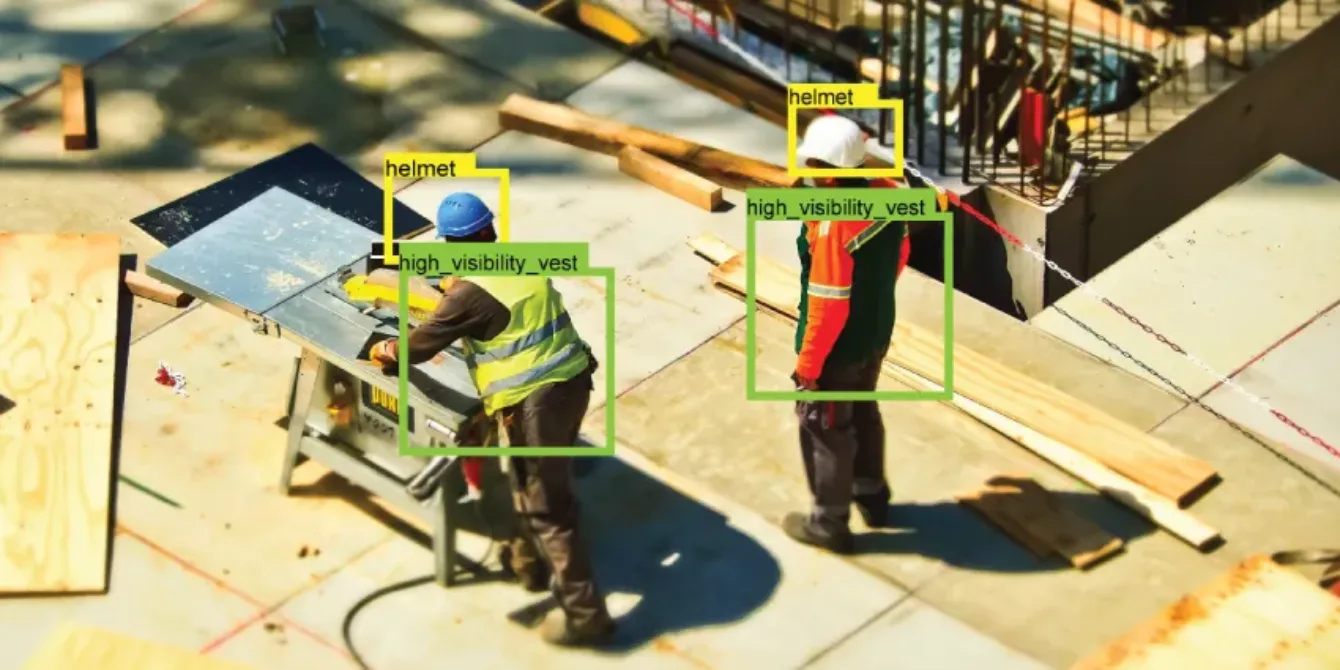
Automated PPE detection – hardhat, vest, gloves – across all monitored zones. Real-time alerts when violations are detected, with video evidence stored for compliance documentation. In our deployments, PPE detection has reached 93% accuracy using standard IP cameras.
→
Progress tracking and documentation
Continuous visual records of construction progress compared against project schedules. Replaces manual photo documentation and periodic site walks with automated, time-stamped evidence of work completed.
→
Zone access control
Detection of unauthorized entry into restricted areas – active crane zones, excavation perimeters, areas with overhead work. Alerts go to site supervisors before incidents happen, not after.
→
Equipment utilization tracking
Monitoring of heavy machinery usage, idle time, and positioning across the site. Gives project managers real data for equipment allocation decisions instead of relying on foreman estimates.
The key advantage across all of these: the same camera infrastructure serves multiple purposes simultaneously. A camera monitoring PPE compliance can also track progress, detect zone violations, and log equipment movements. Adding a new monitoring capability means deploying a new AI model, not installing new hardware.
What Makes This Moment Different from Previous AI Hype
Construction has seen technology promises before. BIM was going to transform everything. Drones were going to replace site inspections. IoT sensors were going to make every beam and bolt intelligent. Some of these delivered value. Many didn’t – at least not at the scale the vendor presentations suggested.
Computer vision in 2026 is different for one practical reason: it doesn’t require the construction company to change how they build. It works with existing cameras, existing site layouts, and existing workflows. A safety officer doesn’t learn a new system – they receive alerts on the same devices they already carry. A project manager doesn’t adopt a new methodology – they get better data for the decisions they already make.
The adoption barrier for computer vision is lower than for almost any other construction technology because it augments existing operations rather than replacing them. The cameras are already installed. The safety protocols already exist. The project management processes are already in place. CV adds an intelligence layer on top of what’s already there.
That said, the technology isn’t a silver bullet. Camera angles limit what the system can see. Lighting and weather conditions affect accuracy. The evolving nature of construction sites – structures change shape weekly – means camera positions need periodic reassessment. And like any AI system, the models need ongoing maintenance as conditions change.
But the core value proposition is sound: continuous, automated monitoring of what’s happening on your site, delivered through infrastructure you already own, at a cost that mid-market construction companies can justify.
Where This Goes Next
The immediate opportunity is straightforward – safety compliance and progress documentation are the highest-value, lowest-friction starting points for most construction companies. These address real pain points (OSHA compliance, project delay documentation, insurance requirements) with measurable ROI.
Longer term, the same infrastructure enables predictive capabilities that construction hasn’t had access to before: identifying patterns that precede safety incidents, detecting schedule slippage before it becomes visible on a Gantt chart, and providing the kind of continuous site intelligence that lets project managers make decisions from data rather than gut feel.
At Agmis, we’ve been deploying computer vision solutions for construction and industrial environments across the EU and Baltic markets. We ran a 3-month pilot with Merko and Mitnija – two of the largest construction companies in the region – and the results confirmed what the economics were already suggesting: the technology is ready for mainstream construction, not just innovation pilots.
If you’re evaluating whether computer vision makes sense for your next project, we’re happy to start with a camera coverage assessment and show you what’s realistically achievable with the infrastructure you already have.
Get a clear path forward.
Share your challenge and walk away with concrete next steps - whether you're exploring AI, automating a process, or scoping a custom software project.
- Honest assessment of your situation - no sales pitch
- Actionable next steps you can use right away
- AI, automation, and custom software expertise