

Amazon shut down its AI vision service in 2025. Google consolidated its dedicated manufacturing inspection tool into a broader platform as part of its Vertex AI migration. Two of the biggest technology companies on earth tried to build generic AI quality control tools and quietly walked away from them as standalone products.
Meanwhile, specialized AI QC platforms are thriving. Companies like Keyence, Cognex, Landing AI, and Instrumental keep growing. Custom-built solutions continue to deliver results that off-the-shelf tools can’t match for specific production lines.
The market for AI in manufacturing quality control is projected to grow from $17.1 billion in 2026 to $124.3 billion by 2034. Quality costs manufacturers 15-20% of annual sales revenue. The problem isn’t whether to adopt AI QC – it’s which route to take.
This post breaks down every major option with honest tradeoffs. Not a sales pitch. A map.
The Landscape: What Actually Exists
Before you can decide build vs buy, you need to know what “buy” actually means in 2026. The market has sorted into four distinct categories, each with fundamentally different economics.
Category 1: Hardware-Bound Vision Systems
These are traditional machine vision companies that added AI. You buy their cameras and their software together. They own the full stack.
Category 2: Software-Only AI Platforms
These are the new generation. No hardware lock-in. Your cameras, their AI. Deploy in the cloud, on-prem, or at the edge.
Category 3: Specialized Niche Platforms
Built for one industry. They do one thing better than any general platform could.
Category 4: Cloud Platforms (Build on Top)
Infrastructure for building custom solutions. Not turnkey – you build your inspection app using their tools.
The “Build” Side: What Custom Development Actually Means
The Amazon Lookout for Vision shutdown is a signal worth paying attention to. If AWS – with its engineering resources, data, and distribution – couldn’t make a generic AI QC service viable, maybe the problem is harder than “just train a model.”
Generic platforms work when the problem is the same across customers. AI quality control isn’t. Every production line has different lighting, different defect types, different materials, different speed requirements, different acceptable quality levels. This is the same dynamic explored in our analysis of data inflation in AI: foundation models handle what’s generic across industries, but the last-mile competitive advantage comes from what’s operationally specific to your production environment – your lighting conditions, your defect signatures, your material variants. That specificity cannot be replicated by any off-the-shelf solution.
That’s where custom development comes in.
What custom AI QC development typically includes
• Camera selection and positioning (lighting is the hardest problem)
• Data collection and labeling (images covering normal + defect variations)
• Model architecture selection and training (YOLO, Mask-RCNN, or custom architectures)
• Edge deployment pipeline (on-device inference at production speed)
• Integration with existing MES, PLC, and rejection systems
• Continuous retraining pipeline as new defect types emerge
• False positive management and operator feedback loops
Recent research on CNN-based defect detection shows that custom architectures can achieve 98.7% accuracy with 3.53ms inference time. But that accuracy comes from training on your specific data – not a generic model.
This is also where data infrastructure matters. If you’re building custom AI QC, you need a platform to store, version, and process inspection data. Open-source data lakehouse solutions like Ilum provide the infrastructure layer for managing production data at scale. But you’ll still build the inspection models yourself or with a computer vision consulting partner.
The Framework: Build, Buy, Boost, or Bridge
The binary “build vs buy” framing is outdated. The realistic decision in 2026 has at least four options:
| Option | What It Means | When It Works |
|---|---|---|
| Buy | Purchase a turnkey platform or hardware system | Standard inspection tasks, known defect types, well-understood production-line QC where a platform fits |
| Boost | Start with a platform, customize for your specific defects | Most common situation. 80% platform reliability + 20% custom model training for unique products |
| Build | Full custom development from camera selection to deployment | Novel defect types, unusual production environments, proprietary processes, multi-sensor needs |
| Bridge | Integrate multiple platforms with custom middleware | Multi-stage inspection across different production steps requiring different technologies |
As CIO.com noted, modern AI deployments succeed when organizations fuse vendor models with internal agents under shared governance. The binary framing misses the reality: most successful AI QC deployments are hybrid.
The Six Factors That Determine Your Decision
Before you decide, know where you stand
The most common failure pattern in AI QC is buying the wrong solution for your maturity level. A company at digital maturity Level 1 (manual processes) that buys an enterprise AI platform will fail – not because the platform is bad, but because they lack the data infrastructure, team, and processes to use it. Take our Digital Maturity Assessment before you invest in any AI QC tool. It takes 5 minutes and tells you which category of solution you’re actually ready for.
Price Comparison: What Different Routes Actually Cost
| Approach | Entry Cost | Year 1 (est.) | Year 5 (est.) | Best For |
|---|---|---|---|---|
| Keyence IV3 | $2,000 | $2,000 + install | $2,000 + maintenance | Simple single-station tasks |
| Cognex In-Sight 2800 | $5,000 | $6,000-8,000 | $6,000-10,000 | Complex single-station tasks |
| Elementary VisionStream | $4,500/camera | $5,000-15,000 | $5,000-15,000 | Per-camera, mid-range |
| Landing AI Enterprise | $0 (free tier) | $50,000-150,000 | $250,000-750,000 | Flexible software-only vision |
| Instrumental | $0 (pilot) | $50,000-100,000 | $250,000-500,000 | Electronics + test data |
| Zanus AI | $19,900 | $25,000-50,000 | $25,000-50,000 | General mfg AI OS |
| TOMRA sorting machine | $50,000+ | $55,000-600,000 | $75,000-800,000 | High-volume food processing |
| Custom build (with partner) | $0 | $100,000-250,000 | $150,000-400,000 | Unique processes, novel defects, multi-sensor |
Gartner notes that organizations overlook 50-70% of total software ownership costs – integration, training, customizations, workarounds, license increases. That applies to both custom and off-the-shelf. A Capgemini Research Institute study found that organizations deploying AI at scale see significant ROI improvements, with manufacturers among the top adopters. The failures almost always trace back to mismatched solution – and the mismatch comes from skipping the assessment phase.
How to Make the Decision: A Practical Process
Baseline Your Current State
Before evaluating any solution, measure your current QC performance. Use the metrics framework we’ve outlined here: defect escape rate, false positive rate, inspection cycle time, cost per inspected unit. Without a baseline, you can’t measure improvement.
Map Your Requirements
Document your defect types (known vs novel), production speed, lighting conditions, product variations, and integration needs. A simple inspection on a well-controlled line is a different problem than a multi-variant line with unpredictable defects.
Run a Structured Pilot
Use the Shadow – Parallel – Live validation framework. Shadow mode (AI watches but doesn’t act) costs nothing and tells you more than any vendor demo. Parallel mode (AI and human inspect independently) validates accuracy before trust. Live mode only after both pass your thresholds.
Consider the Hybrid
The “Buy, Boost, or Build” framework suggests buying 60% of what you need from platforms and building the 40% that gives you competitive advantage. For AI QC, this often means buying a camera platform (Keyence or Cognex) for baseline inspection and building custom models for the hard defects that keep escaping.
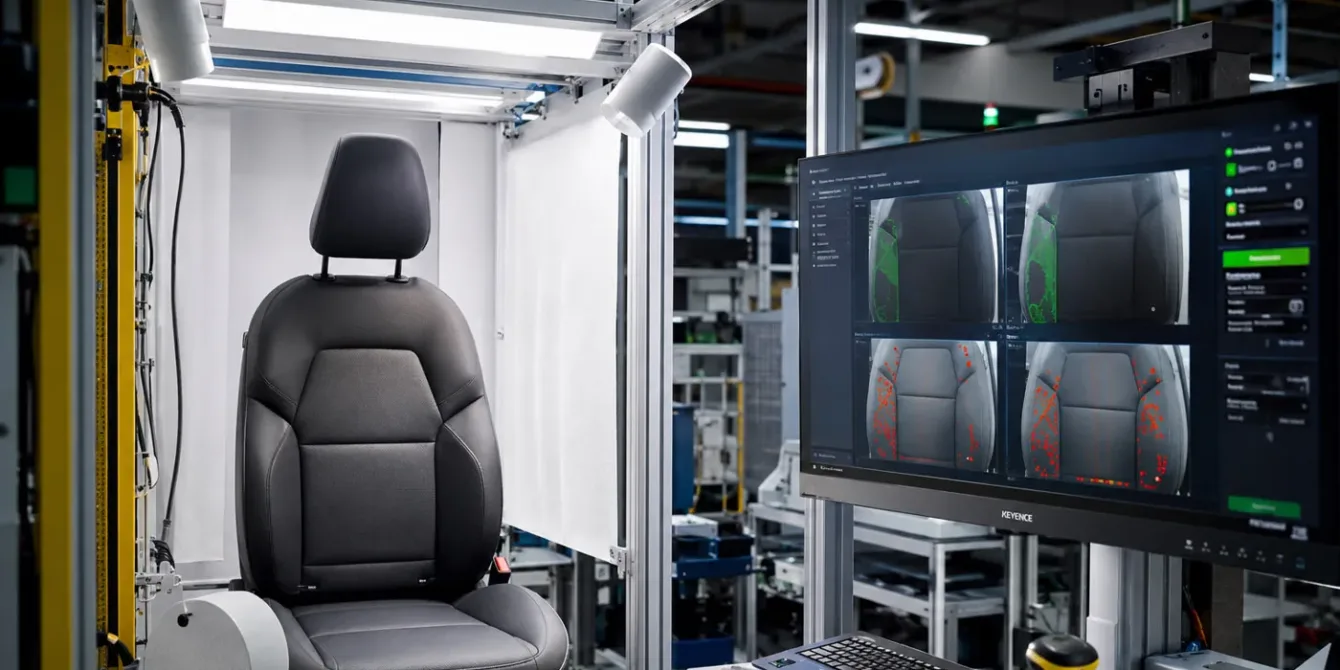
At Agmis, we’ve seen this pattern work repeatedly: a custom computer vision deployment for an automotive seat manufacturer achieved 27x faster inspection, 99% detection accuracy, and ~30x cost savings compared to manual inspection. That level of ROI came from a custom approach tailored to their specific defects and production environment – not a generic platform.
Which Route Should You Take?
| Your Situation | Best Route | Why |
|---|---|---|
| Standard defect types, single product line | Buy (Keyence, Elementary, or Landing AI) | No-code setup, proven for known defects, lowest entry cost |
| Complex defects, high speed, multi-product | Boost (platform + custom models) | Platform handles baseline, custom models address the hard 10% |
| Novel / unpredictable defects | Build custom or use Instrumental | Only custom or Instrumental detects what you haven’t seen before |
| Very high volume, food processing | TOMRA or similar hardware | Physical sorting machines at scale beat software-only |
| Electronics, need test data too | Instrumental | Only platform combining visual + functional test |
| Fresh produce supply chain | Clarifresh | Niche mobile-first platform purpose-built for produce |
| Unique process, proprietary, multi-sensor | Build custom | No off-the-shelf platform fits your specific process |
The Bottom Line
The AI quality control market is growing fast enough that there’s room for multiple approaches. The question isn’t which one is “best” – it’s which one fits your production environment, team, defect types, and maturity level.
Hardware-bound systems from Keyence and Cognex are reliable and field-tested but expensive at scale. Software-only platforms from Landing AI and Cogniac offer flexibility but can’t handle novel defects. Specialized tools like Instrumental and Clarifresh do one thing brilliantly but only for their niche. And sometimes, the right answer is to build – not because you want to, but because your specific problem is different enough that no platform solves it.
If you want to understand what those results look like in practice, our detailed breakdown of the path to 99% defect detection in manufacturing covers the full implementation – from imaging setup and training data to ROI and the limitations that apply even to well-tuned custom systems.
Before you buy or build: Understand your digital maturity level. If you’re unsure which route fits your situation, talk to someone who’s done this before. A one-hour conversation can save six months of wrong direction.