
AI Quality Control for Automotive Seat Manufacturing
AI Quality Control for Automotive Seat Manufacturing
Agmis deployed an intelligent defect detection system for one of the world's largest automotive seat producers, achieving 99% accuracy and reducing inspection time by 27x.
Global Leader in Automotive Seat Manufacturing
The client operates as one of the world's largest automotive seat producers, manufacturing thousands of units daily across multiple product lines. In an industry where comfort, safety, and visual perfection define competitive advantage, maintaining consistent quality across over 40 unique seat models demands inspection capabilities that exceed human limitations.
Manual Inspection Cannot Keep Pace with Production Demands
Time-Intensive Process
Traditional manual inspection required approximately 1 minute per part - a bottleneck that constrained production throughput and created labor cost pressures across high-volume manufacturing lines.
Human Error Vulnerability
Detecting subtle wrinkles and surface imperfections across diverse seat materials proved difficult for human inspectors. Fatigue, inconsistency, and the inherent limitations of visual inspection led to defects reaching later production stages.
Material Complexity
With over 40 unique automotive seat models featuring varied textures, finishes, and materials, maintaining uniform inspection standards across the entire product range challenged traditional quality control methods.
Profitability Impact
Undetected defects meant rework, waste, and potential warranty claims - each missed imperfection directly impacting manufacturing efficiency and bottom-line profitability.
Intelligent AI Quality Control Powered by Computer Vision
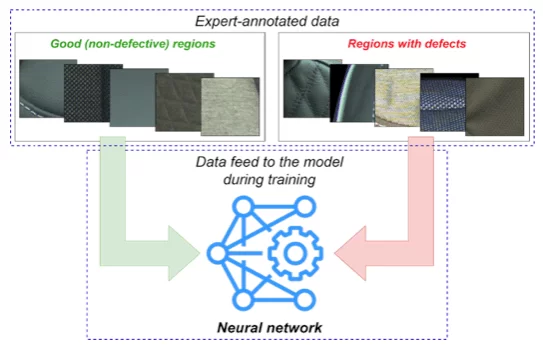
Agmis developed Seat Checker, an AI quality control solution that leverages deep learning algorithms to identify defects in automotive seats with speed and precision that far exceeds human capability.
Real-Time Defect Detection: Computer vision analyzes each seat as it moves through production, identifying wrinkles, surface imperfections, and material anomalies in just 2.2 seconds per part - replacing the 1-minute manual inspection process.
Self-Learning Algorithms: The automated inspection system adapts to various textures and finishes autonomously, learning to recognize defects across the full range of seat materials without requiring manual recalibration for each product variant.
Subtle Imperfection Recognition: Deep learning models detect even minor wrinkles and surface irregularities that escape human visual inspection, ensuring defects are caught before they progress through production.
Seamless Production Integration: The platform integrates directly into existing production lines, enabling manufacturers to implement automated defect detection without disrupting established workflows or requiring significant infrastructure changes.
Scalable Accuracy: Whether inspecting one seat model or forty, the system maintains consistent 99% accuracy - eliminating the variability inherent in human inspection across shift changes and extended production runs.
Measurable Improvements Across Quality Operations
27x Faster Inspection
Automated quality inspection reduced inspection time from approximately 1 minute per part to just 2.2 seconds - transforming a production bottleneck into a streamlined checkpoint.
99% Detection Accuracy
The system achieves near-perfect defect identification, surpassing human inspection capabilities and ensuring consistent, reliable quality across every unit.
30x Cost Savings
By eliminating human bottlenecks and reducing tact time, intelligent inspection delivered approximately 30x cost savings compared to manual processes.
Workforce Optimization
Automated inspection frees employees from repetitive visual tasks, enabling them to focus on supervising, optimizing, and higher-value activities that benefit from human judgment.
Consistent Performance
Unlike human inspectors who experience fatigue and variability, AI quality control maintains identical precision from the first unit of the day to the last - across every shift, every day.
Multi-Model Flexibility
A single system handles the full range of 40+ seat models, adapting to different materials and finishes without requiring separate inspection protocols for each variant.
Reduced Defect Escape
Catching imperfections at the point of production prevents defective units from advancing through manufacturing stages, eliminating costly rework and potential warranty issues downstream.
Production Line Harmony
Seamless integration means enhanced operations rather than disrupted ones - manufacturers gain inspection capabilities without sacrificing production continuity.
Beyond Automotive: Automated Quality Inspection for Furniture Manufacturing
The same computer vision technology that detects wrinkles in automotive seats applies directly to furniture production. Upholstered furniture faces identical challenges: varied materials, subtle surface defects, and the need for consistent inspection across diverse product lines.
AI quality control enables furniture manufacturers to:
Defect Detection
Detect fabric wrinkles, stitching defects, and surface imperfections at production speed
Quality Standards
Maintain quality standards across multiple upholstery materials and furniture models
Automated Precision
Replace slow, inconsistent manual inspection with automated precision
Scalable Operations
Scale inspection capabilities without proportional increases in quality control staff
Whether manufacturing automotive seats or living room sofas, the underlying challenge remains constant: ensuring every unit meets quality standards before reaching customers. Agmis intelligent inspection solutions address this challenge across both industries.
Transforming Manufacturing Through Intelligent Inspection
In manufacturing environments where defects directly impact profitability and brand reputation, AI quality control represents a fundamental shift from reactive quality management to proactive defect prevention.
Speed Without Sacrifice
27x faster inspection doesn't mean compromised accuracy - automated defect detection delivers both, eliminating the traditional trade-off between throughput and precision.
Scalable Excellence
As production volumes grow or product lines expand, intelligent inspection scales without proportional increases in inspection staff or quality management overhead.
Competitive Advantage
Manufacturers implementing computer vision inspection gain the ability to guarantee quality levels that competitors relying on manual inspection cannot match - a differentiator that matters to automotive OEMs and furniture retailers alike.
Data-Driven Quality
Every inspection generates data. Automated systems transform individual defect detection into aggregate insights about material quality, supplier performance, and production process optimization.