

AI PPE detection sounds straightforward – point a camera, detect a hardhat, send an alert. Vendors make it look effortless in demos. Clean footage, perfect lighting, a worker walks into frame wearing obvious safety gear, and the system draws a nice green box around it.
Then you try deploying it in a real facility.
Workers move unpredictably. Lighting shifts throughout the day. The PPE you actually need to detect isn’t hardhats – it’s hairnets, beard nets, face shields, and food-safe gloves that no off-the-shelf model has ever seen.
We’ve been building and deploying computer vision systems for PPE compliance in environments where generic solutions had already failed. Facilities that had tried other vendors. Real production floors with real constraints. Here’s what we actually learned.
The “Just Add AI” Problem
Before getting into solutions, it’s worth understanding why PPE detection is harder than it appears. Most failed deployments share the same root causes.
Generic models don’t know your PPE. Food manufacturing requires hairnets, face shields, beard nets, aprons, and food-safe gloves. Energy facilities need hardhats, high-visibility vests, and safety goggles. Construction sites have different requirements again. Pre-trained computer vision models understand general object recognition, but they weren’t fine-tuned for industry-specific protective equipment. They can’t distinguish between a compliant beard net and an exposed beard – until you train them to.
Demo conditions aren’t factory conditions. Vendor demonstrations happen in controlled environments. Good lighting. Stationary subjects. Clear camera angles. A real production floor has shadows, motion blur, visual obstructions, workers partially hidden behind equipment, and surveillance cameras that were installed years ago for security purposes – not optimized for AI analysis.
Scale breaks manual workarounds. One facility with 50 workers? Maybe a safety officer can do periodic walk-throughs and spot-check compliance. Multiple sites with over 1,600 employees, rotating shifts, and daily contractor traffic? Manual monitoring physically cannot provide consistent coverage. The math doesn’t work.
Documentation is the hidden burden. Detecting a violation is only step one. Recording it with photographic evidence, accurate timestamps, and location data – without requiring someone to manually review hours of camera footage – is where most approaches collapse. Safety teams don’t have time to scrub through video looking for incidents that may or may not have happened.
Previous computer vision vendors had attempted solutions for one of our clients and struggled with exactly these challenges. The technology worked in testing but couldn’t handle the complexity of real food production environments. That’s where we came in.
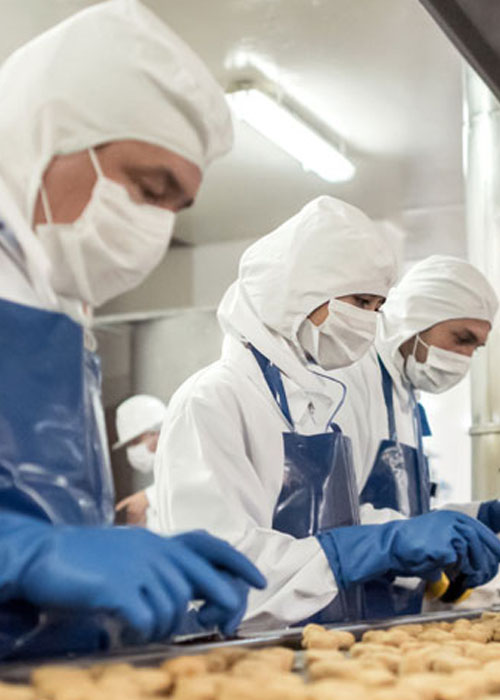

See how Agmis deployed AI-powered PPE detection at one of the Baltic region's largest food manufacturers, monitoring face masks, hairnets, and hygiene equipment with real-time compliance alerts.
What We Had to Build
This wasn’t a matter of configuring off-the-shelf software and hoping it worked. But it also wasn’t building AI from scratch – modern computer vision has moved past that.
Fine-tuned models for industry-specific equipment. We use architectures like YOLO and Vision Transformers that are pre-trained on millions of images – they already understand how real-world objects look. The work is adapting them to recognize the exact PPE used at each facility. A hairnet at a food manufacturing plant, a specific style of face shield, the beard nets workers actually wear.
With proper annotations, fine-tuning takes hours, not months. But getting those annotations right – capturing the variations in how equipment appears across different lighting, angles, and wear conditions – that’s where the real effort goes. Quality of training data matters far more than quantity.
Existing camera integration. No client wants to rip out their surveillance infrastructure. Our system analyzes footage from cameras already installed – which meant adapting to varying angles, different resolutions, and coverage patterns designed for security monitoring, not AI detection. Some cameras worked well. Others required us to work around limitations that couldn’t be changed without significant construction.
Real-time processing architecture. A violation detected eight hours later is operationally useless. By then, the shift has changed, the worker has moved on, and the safety team has no way to intervene. We built for instant alerts – the moment someone enters a monitored zone without proper PPE, designated personnel receive a notification. Seconds, not shifts.
Automated evidence capture. Every detection includes photographic proof, a precise timestamp, and location identification. When a safety manager needs to document an incident or prepare for an audit, the evidence is already compiled. No one has to review footage manually or reconstruct what happened after the fact.
GDPR-compliant architecture. Monitoring workers in the EU means privacy compliance isn’t optional. Data stays within the organization, access controls are strict, and the system meets regulatory requirements while still providing meaningful safety oversight. This shaped technical decisions from storage to deployment.
Scalable multi-site deployment. A solution that works in one building but requires complete reconfiguration for the next isn’t practical for organizations with multiple facilities. The architecture needed to scale – same core system, adaptable to different environments and equipment requirements.
What Actually Worked
After deployment across manufacturing plants, logistics centers, and energy facilities – including an energy sector PPE compliance deployment with demanding environmental and operational constraints – here’s what the numbers show.
Detection accuracy in challenging conditions. We achieved 93% accuracy for vests and hardhats in real manufacturing environments – not controlled testing conditions, but production floors with variable lighting, moving personnel, and visual obstructions. For face mask detection, accuracy reached 100%. In food manufacturing, where masks are critical for hygiene compliance, that reliability matters.
Existing infrastructure, no new hardware. Both major deployments used current surveillance cameras. No costly new installations, no production disruptions while equipment was being set up. The AI PPE detection system worked with what was already there.
24/7 monitoring without additional personnel. Continuous automated monitoring replaced the impossible task of human supervisors watching every zone at every moment. The system doesn’t take breaks, doesn’t get distracted, and doesn’t miss violations because it was focused elsewhere.
Instant violation response. When a worker enters a protected zone without proper equipment, safety specialists receive an alert immediately. Intervention happens in seconds rather than being discovered hours later during footage review – or never discovered at all.
Automated daily reporting. Each morning, safety managers receive a consolidated summary of the previous day’s violations. Patterns become visible. Problem areas get identified. Compliance audits become straightforward because the documentation already exists.
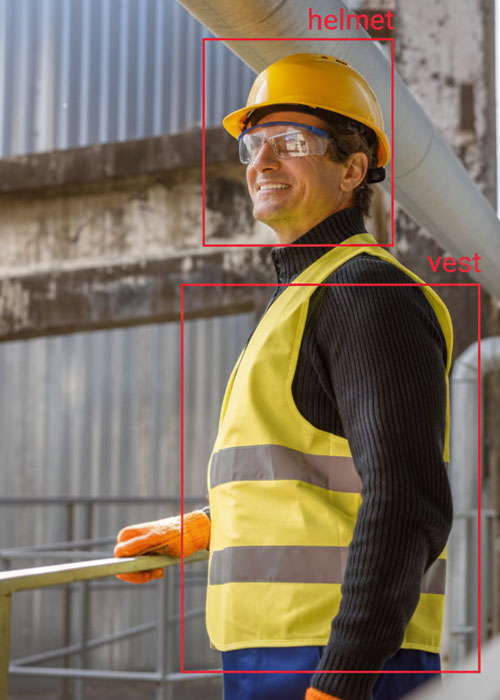

See how Agmis deployed AI-powered PPE detection at Ignitis Kaunas CHP, enabling 24/7 workplace safety monitoring with instant violation alerts and automated compliance reporting.
Beyond Basic PPE Detection
One thing became clear during deployment: once you have computer vision infrastructure analyzing video feeds in real time, PPE detection is just the starting point.
Forklift operator safety. The same cameras monitoring PPE compliance can verify that forklift operators follow safety protocols. Are they wearing seatbelts? Are they observing speed limits in pedestrian zones? The model expands, but the infrastructure stays the same.
Cargo damage identification. During loading and unloading operations, the system can flag visible damage to goods. What started as a safety project added operational value that had nothing to do with protective equipment.
Zone access monitoring. Beyond detecting what someone is wearing, the system tracks where people are going. Restricted areas get an additional layer of oversight without requiring physical barriers or dedicated security personnel.
This wasn’t part of the original scope. But once the foundational computer vision platform existed, extending its capabilities required far less effort than building each application separately. Fine-tune additional models for new detection tasks, deploy them on the same infrastructure. One investment, multiple returns.
What Surprised Us
Lessons from real deployment:
Contractor management required extra attention. Permanent staff learn the facility – which zones require which equipment, where cameras are positioned. Contractors move differently. They arrive daily, work in unfamiliar areas, and don’t have the same ingrained routines. Maintaining consistent compliance across both permanent employees and daily contractor traffic required the system to handle more variability than monitoring a fixed workforce alone.
Environment conditions varied significantly. Multiple facilities meant adapting to different lighting conditions, workflow patterns, and camera positions. What worked in one zone didn’t automatically transfer to another. The system needed robustness across these variations, not just accuracy in ideal conditions.
Visible monitoring changed behavior. Strategic messaging about camera capabilities served as an additional deterrent, encouraging proactive compliance among both permanent staff and visiting contractors. The system’s value wasn’t just catching violations – it was preventing them through awareness.
Daily email summaries proved highly valuable. We built a management interface with real-time monitoring, data visualization, and export capabilities – useful for deeper analysis. But for daily workflow, safety managers found the automated email summaries particularly effective. A consolidated view of yesterday’s violations waiting in their inbox each morning, without needing to log into anything.
What We’re Still Working On
Active areas of refinement:
Adapting to new equipment. When facilities introduce new protective equipment or switch suppliers, the models need fine-tuning with new annotated images. Modern transfer learning keeps this fast – hours of training, not weeks – but it’s still a process that requires collecting and labeling new examples.
Edge case improvement. Partial obstructions, unusual angles, workers in positions that obscure equipment – these scenarios can produce occasional misses. The system improves with more representative training data, but challenging conditions will always require ongoing attention.
Integration with existing workflows. Some facilities have modern safety management platforms. Others rely on spreadsheets and email. The software development work to connect computer vision outputs with existing processes varies based on what’s already in place.
Integration with legacy systems varies. Some facilities have modern safety management platforms that connect easily. Others run processes on spreadsheets and email. The software development work to integrate computer vision with existing workflows differs significantly based on what’s already in place.
Where AI PPE Detection Is Heading
Based on what we’re already seeing in deployments:
Expanded monitoring scope. PPE detection was the starting point. The same infrastructure now handles forklift operator safety monitoring and cargo damage identification during loading and unloading. One computer vision platform, multiple applications.
Scaling with facility growth. Organizations planning expansion – new plants, larger workforces – need safety monitoring that scales without proportional increases in personnel. AI monitoring adds coverage to new buildings at marginal cost compared to hiring additional safety staff.
Comprehensive safety documentation. Automated evidence capture with photographs, timestamps, and location data simplifies compliance audits. The shift from manual documentation to system-generated records is already underway.
The Bigger Picture
PPE compliance has historically been framed as a discipline problem. Workers don’t follow rules. Supervisors don’t enforce consistently. More training, more signage, more penalties.
But spend time in facilities actually trying to maintain compliance, and a different picture emerges. The problem isn’t that workers are careless or supervisors are negligent. The problem is that consistent monitoring at scale is physically impossible with human oversight alone. No safety team can watch every zone, every shift, every contractor, every moment.
Computer vision changes that equation. Not by replacing human judgment – decisions about safety policy, violation response, and compliance priorities remain human responsibilities. But by providing consistent detection that doesn’t fatigue, documentation that doesn’t require manual review, and coverage that doesn’t depend on where a supervisor happens to be standing.
The technology isn’t magic. It requires proper training data, thoughtful integration, and ongoing refinement. Models need updates when equipment changes. Edge cases need attention. But the barrier to deploying real AI PPE detection has dropped dramatically. What used to require massive datasets and months of development now happens with targeted images and hours of fine-tuning.
For facilities serious about safety compliance – not as a checkbox, but as an operational reality – computer vision is no longer experimental. It’s deployable. And the results are measurable.