Solar farms keep getting bigger. A utility-scale installation might span thousands of acres with hundreds of thousands of individual panels. Each one can develop cracks, hotspots, soiling buildup, or connector issues that silently drain energy output.
The traditional approach – technicians walking rows with handheld equipment – worked when installations were smaller. At current scales, it doesn’t. A manual inspection of a large solar farm can take weeks. And even drone capture alone just shifts the bottleneck: you end up with thousands of images and no efficient way to analyze them.
AI-powered drone inspection solves both problems. Drones capture thermal and visual data at scale. Computer vision models analyze that data faster and more consistently than human review. The combination delivers something neither can achieve alone: comprehensive defect detection across massive installations, with results you can actually act on.
Here’s how it works in practice – and where the real challenges sit.
The Scale Problem (And Why Drones Alone Don’t Solve It)
A technician with handheld thermal equipment might inspect a few hundred panels per day under good conditions. A utility-scale solar farm has hundreds of thousands. The math doesn’t work.
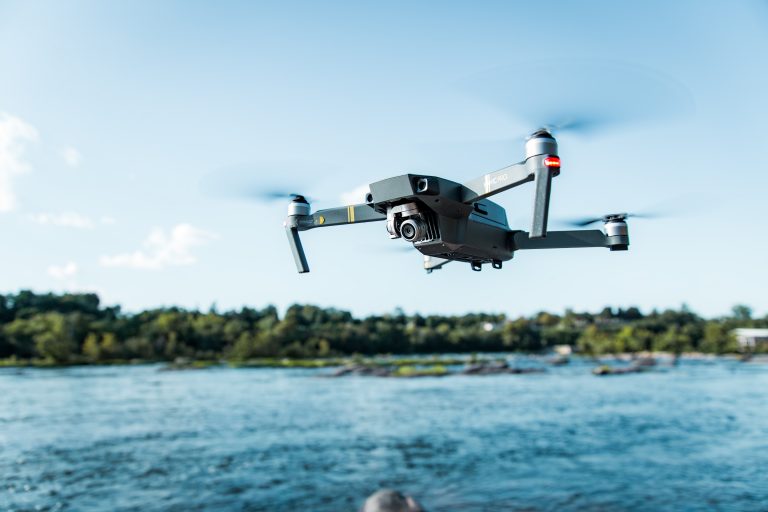
Drones changed the capture equation. A single flight covers in minutes what takes hours on foot. The coverage is systematic, the data capture consistent.
But early drone inspection programs hit a different wall: data overload. A single flight generates thousands of high-resolution images. Someone still has to review them, identify anomalies, classify defect types, and prioritize repairs. At that volume, manual analysis becomes its own bottleneck. Teams found themselves with impressive aerial footage and no efficient way to extract value from it.
This is where AI becomes essential – not as a nice-to-have feature, but as the component that makes large-scale inspection operationally viable.
How AI-Powered Drone Inspection Works
The workflow combines three elements: systematic data capture, automated analysis, and actionable output.
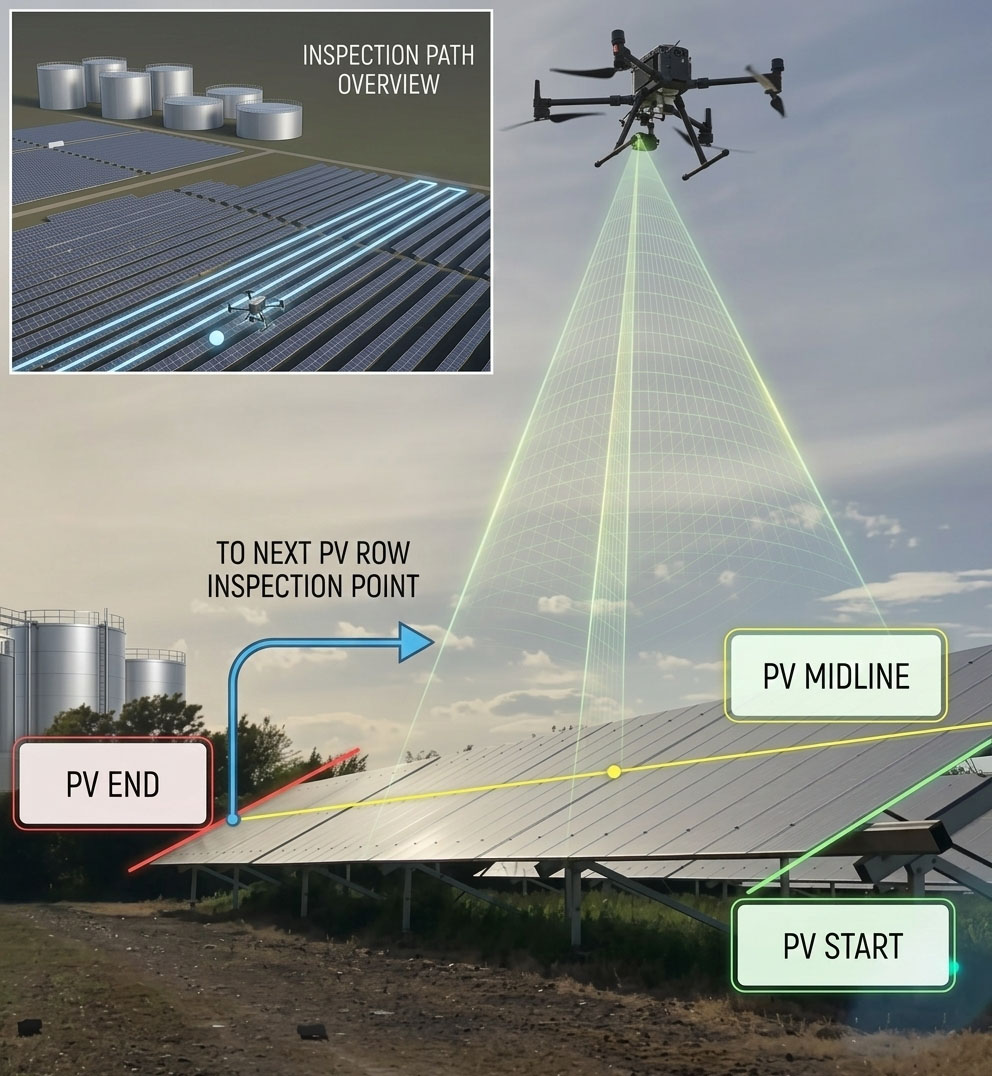
Flight operations and data capture. Drones follow pre-programmed flight paths designed to systematically cover the installation. Altitude, speed, and overlap between image captures all affect data quality. Most inspection drones carry dual camera systems – RGB for visual imagery and thermal for heat detection. Each image is timestamped and GPS-tagged.
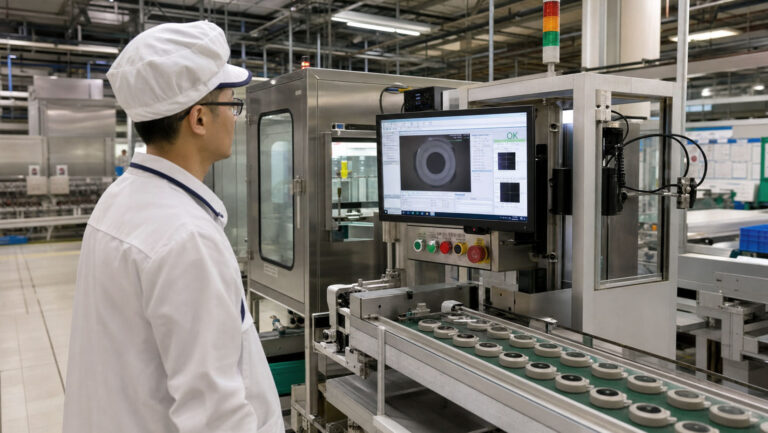
AI-powered defect detection. Computer vision models – typically architectures like YOLO or convolutional neural networks – process the captured imagery automatically. These models are trained to identify anomalies in both thermal and visual data: hotspots, cracks, soiling patterns, vegetation encroachment, damaged connectors. What would take a technician days to review manually, AI processes in hours.
Classification and prioritization. Detection alone isn’t enough. AI models classify what they find – distinguishing a minor hotspot from a failing junction box, surface soiling from embedded damage. This classification drives prioritization, helping maintenance teams focus on issues that matter most.
Reporting and integration. Analyzed results feed into maintenance workflows: defect locations, severity ratings, recommended actions, trend data from previous inspections. The output connects inspection to action.
What AI Detects in Thermal Imagery
Thermal cameras detect heat radiation. Problems in solar panels generate heat. AI interprets what those thermal patterns mean.
Hotspots appear when cells or panel sections operate at higher temperatures than their surroundings. Causes include damaged cells, poor solder connections, bypass diode failures, or partial shading. In raw thermal imagery, these show as bright spots – but distinguishing meaningful anomalies from normal variation requires trained analysis. AI models learn these distinctions across thousands of examples.
String-level anomalies indicate problems affecting connected groups of panels. A single failing connection impacts an entire string’s performance. AI identifies thermal patterns across multiple panels to pinpoint where in the circuit problems originate.
Potential-induced degradation (PID) creates distinctive thermal signatures as affected cells lose efficiency. AI models trained on PID patterns catch it earlier than manual review typically would – and early detection matters because PID spreads.
Connection and junction box issues generate localized heating from electrical resistance. These can escalate from efficiency losses to fire risks. AI flags the thermal signatures before problems become dangerous.
The advantage over manual thermal review: consistency. AI applies the same detection criteria to image 5,000 as it did to image 1. Human attention doesn’t work that way.
What AI Detects in Visual Imagery
Not everything shows up in thermal data. Visual analysis – powered by the same computer vision approaches – catches different defect types.
Cracking from manufacturing, handling, installation, or environmental stress. AI models trained on crack patterns identify damage that might be subtle to the human eye, especially across thousands of images where attention fatigue becomes a factor.
Soiling and debris reduce light absorption and panel output. AI quantifies soiling levels across installations, identifying patterns – which sections accumulate faster, which cleaning schedules are insufficient. This turns visual data into operational insight.
Vegetation encroachment and shading from growing trees or nearby structures. AI combined with solar path modeling identifies shading losses that occur only during certain times of day or seasons – problems invisible in a single snapshot but clear in analyzed data over time.
Physical damage from weather, animals, or equipment. Post-storm assessments benefit particularly from AI analysis: quickly processing imagery from across an installation to assess damage scope and prioritize response.
Trend Analysis: Where AI Value Compounds
Single inspections provide snapshots. The deeper value emerges over time.
AI-powered analysis across multiple inspection cycles reveals patterns that single reviews miss:
Degradation tracking. Which panels are losing efficiency faster than fleet averages? AI comparing thermal signatures over months or years identifies accelerated degradation before it becomes severe.
Recurring problem areas. Some installation sections develop issues repeatedly – maybe due to environmental factors, installation quality, or equipment batches. AI surfaces these patterns from data that would be impossible to track manually across large installations.
Predictive maintenance indicators. Historical defect patterns help predict where future problems are likely. This shifts maintenance from reactive (fix what’s broken) to predictive (address what’s about to fail).
Cleaning optimization. Soiling analysis over time reveals which areas need more frequent cleaning, which schedules are wasteful, and how weather events affect accumulation. Data-driven cleaning schedules replace arbitrary ones.
This trend analysis requires consistent data capture and consistent AI analysis across inspection cycles. The investment in standardized processes pays off in compounding insight.
Practical Limitations
AI-powered drone inspection isn’t perfect. Honest assessment includes what it doesn’t do well.
Weather constrains operations. High winds ground drones. Rain compromises equipment and image quality. Optimal thermal imaging conditions – often early morning for clearest temperature differentials – don’t always align with operational schedules.
AI models require training for specific conditions. Models trained on one panel type or environment may not perform optimally on another. Mounting configurations, panel technologies, and environmental factors affect what “normal” looks like in thermal imagery. Some customization and validation is typically necessary for new installations.
Detection accuracy isn’t 100%. AI catches most anomalies, but edge cases exist. Unusual defect presentations, image quality issues, or conditions outside training data can produce misses or false positives. Human review of flagged items remains part of effective workflows.
Integration determines value. AI-generated defect reports are only useful if they reach maintenance teams and connect to work order systems. Organizations with fragmented operational systems face harder integration challenges.
AI augments expertise – it doesn’t replace it. Automated detection identifies anomalies. Determining root causes and appropriate responses still requires human expertise. Computer vision makes maintenance teams more effective; it doesn’t eliminate the need for them.
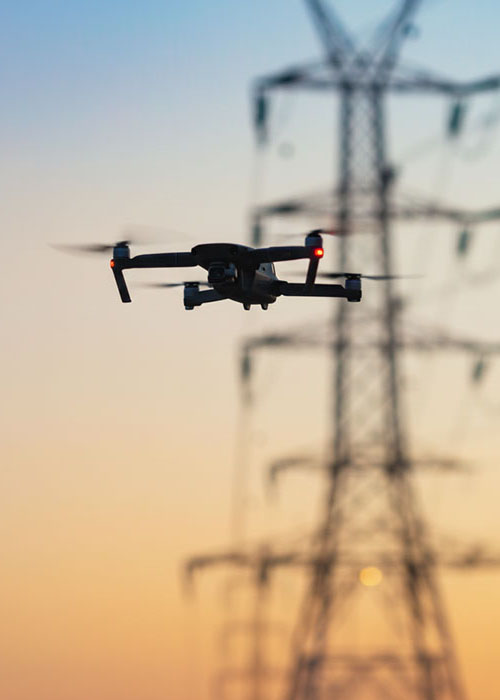

See how Agmis achieved 96% precision in power grid element detection for Lithuania's national energy distribution operator, processing 200,000 photos and 700km of LiDAR data.
Making AI-Powered Inspection Work
For organizations implementing these programs, a few principles hold:
Build analysis capacity alongside flight operations. Drone capture without AI analysis recreates the data overload problem. Ensure processing and analysis systems – whether internal or through partners like Agmis – are part of the program from day one.
Start with baselines. AI trend analysis requires historical data. First inspections establish current conditions. Value compounds with subsequent surveys that reveal patterns over time.
Validate AI performance on your installation. Before trusting automated detection fully, validate results against manual inspection of sample areas. This builds confidence and identifies any model adjustments needed for your specific conditions.
Connect to maintenance workflows. Inspection findings that don’t reach maintenance teams don’t improve anything. Integration between AI analysis outputs and operational systems matters more than either in isolation.
Plan for ongoing model refinement. As equipment changes, new defect types emerge, or installation conditions evolve, AI models may need updates. Build this into program expectations rather than treating initial deployment as final.
Where This Is Heading
Solar capacity keeps growing. Installations keep getting larger. The operational challenge of maintaining these assets at scale intensifies.
AI-powered drone inspection has moved from experimental to standard practice because the fundamentals work: drones capture data at scale, AI analyzes it faster and more consistently than manual review, and the combination delivers actionable maintenance intelligence.
The technology continues improving. Detection accuracy increases as models train on larger datasets. Integration with maintenance systems gets smoother. Predictive capabilities strengthen as historical data accumulates.
For most large-scale solar operations, the question has moved from “should we use AI-powered inspection?” to “how do we implement it effectively?” The organizations getting the most value treat it as an integrated system: flight operations, AI analysis, and maintenance workflows connected into a coherent program.
Get a clear path forward.
Share your challenge and walk away with concrete next steps - whether you're exploring AI, automating a process, or scoping a custom software project.
- Honest assessment of your situation - no sales pitch
- Actionable next steps you can use right away
- AI, automation, and custom software expertise