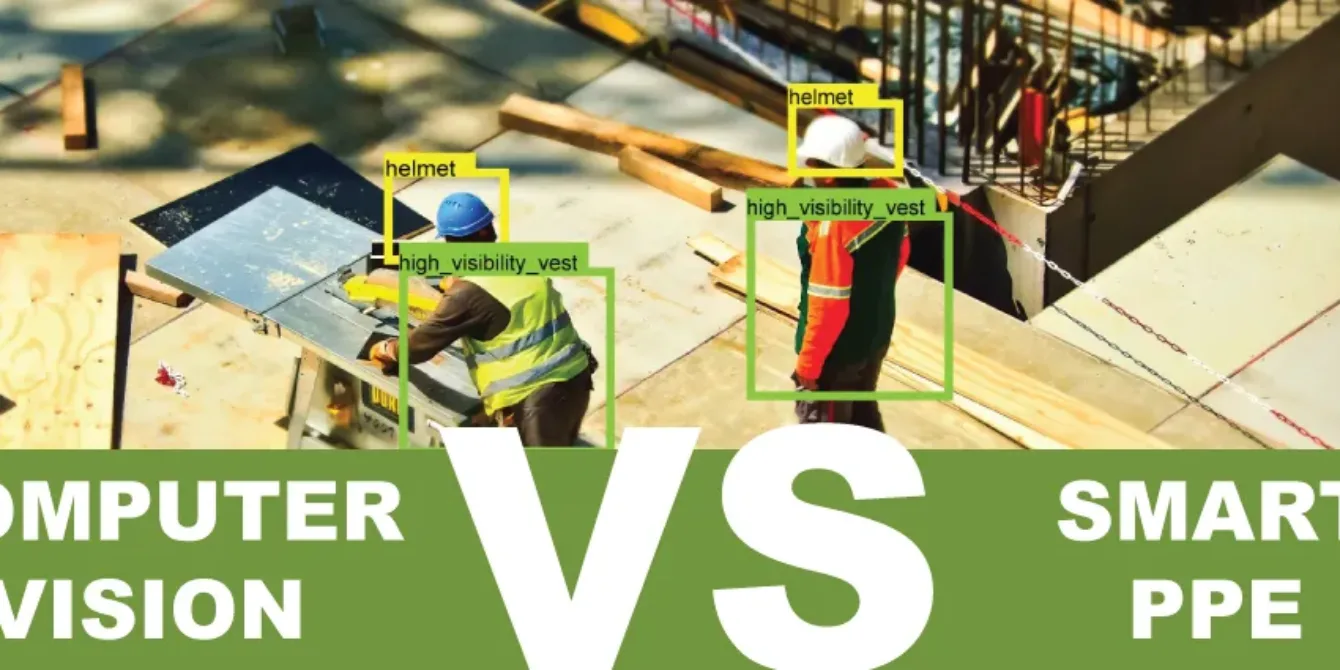
Computer vision and smart PPE wearables both promise real-time safety monitoring on construction sites – but they solve the problem differently, cost differently, and fail differently. In our deployments with construction companies like Merko and Mitnija, computer vision delivered 93% PPE compliance accuracy using existing CCTV cameras with near-zero hardware cost per worker. Smart PPE offers something CV can’t: biometric monitoring and individual health tracking. Here’s how to decide which approach fits your site.
Quick Decision Guide:
Choose computer vision if you need site-wide PPE compliance monitoring at scale without per-worker hardware costs
Choose smart PPE if you need individual biometric data (fatigue, heat stress, gas exposure) alongside compliance tracking
Consider both if you’re running a large site where health monitoring and visual compliance serve different safety gaps
Why This Comparison Matters Now
Construction remains one of the deadliest industries worldwide, and PPE non-compliance is a central factor. In the U.S., 1,034 construction workers died on the job in 2024, with fall protection topping OSHA’s most-cited violations for the fourteenth consecutive year. In the UK, 42% of construction workers admit to not always following safety processes – even when regulations exist and PPE is provided.
The problem isn’t a lack of rules. It’s a lack of enforcement at scale.
Manual safety inspections rely on a supervisor being in the right place at the right time. On a large construction site with hundreds of workers across multiple zones, that’s a statistical impossibility. A safety officer can walk a site, check compliance in one area, and miss a violation happening 200 meters away at the same moment.
Both computer vision and smart PPE wearables are designed to fill this gap. But they approach the problem from fundamentally different directions, with different cost structures, different strengths, and different failure modes.
We’ve worked with both approaches. Here’s what we’ve actually learned.
Computer Vision vs Smart PPE: Side-by-Side Comparison
| Factor | Computer Vision | Smart PPE Wearables |
|---|---|---|
| What it monitors | PPE worn/not worn, unsafe behavior, zone access | PPE worn/not worn, biometrics, environmental hazards |
| Hardware needed | Existing CCTV cameras (usually already installed) | Sensor-equipped helmets, vests, wristbands per worker |
| Cost per worker | Near zero | $200-$800+ per device |
| Connectivity | Standard wired/IP camera network | Bluetooth, WiFi, or LTE across entire site |
| Scalability | Scales with camera coverage, not headcount | Cost scales linearly with workforce size |
| Biometric monitoring | No | Yes |
| Incident evidence | Video footage stored automatically | Sensor data only — no visual context |
| Deployment time | Days to weeks (software configuration) | Weeks to months (hardware + connectivity) |
| PPE detection accuracy | 90-95% in production environments | High for worn/not-worn (sensor-dependent) |
| Works underground / remote | Needs camera infrastructure | Needs wireless connectivity (often unavailable) |
Smart PPE Wearables: What They Actually Deliver
Smart PPE embeds sensors, beacons, and communication modules directly into hardhats, goggles, earmuffs, and vests. Think of it as a FitBit for industrial applications – except instead of tracking your morning run, it’s monitoring whether a worker is showing signs of heat exhaustion at 2 PM on a concrete pour.
The technology is real and the use cases are legitimate. Smart helmets can monitor fatigue levels and alert supervisors when alertness drops. Wristbands track heart rate and body temperature. Gas detection sensors in smart vests warn workers before they walk into hazardous concentrations. Environmental monitoring – noise levels, temperature extremes, vibration exposure – gives safety teams data they’ve never had before.
For individual worker health and safety, this is genuinely valuable. No camera system can tell you that a worker’s core temperature is rising dangerously.
Where smart PPE struggles:
Cost per user is the primary barrier. Every worker on site needs smart equipment. For a site with 200 workers – and turnover is common in construction – you’re equipping, maintaining, tracking, and replacing hundreds of devices. The economics get difficult fast.
Connectivity is the second problem. Smart PPE requires a constant connection to a central system for real-time data reporting. Bluetooth, WiFi, or LTE – pick your challenge. Construction sites are dynamic. Workers move between floors, into partially enclosed structures, underground. Maintaining reliable wireless coverage across an active site is a project in itself. In some environments – mining, underground infrastructure – consistent connectivity simply isn’t available.
No visual evidence for incident analysis. When a sensor flags a PPE breach – say, a hardhat was removed – you get a data point. What you don’t get is context. Was the worker adjusting equipment? Did they remove it for 3 seconds or 30 minutes? Was anyone else in the area also non-compliant? Without supporting video, you have an alert but not the full picture. This matters for incident investigation and compliance documentation.
Sensor reliability. Sensors malfunction. Equipment gets damaged on construction sites – that’s the nature of the environment. A malfunctioning sensor can trigger false alerts or, worse, fail silently and create a false sense of security.
Computer Vision PPE Monitoring: What It Actually Delivers
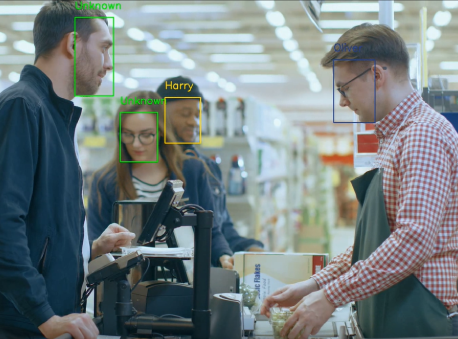
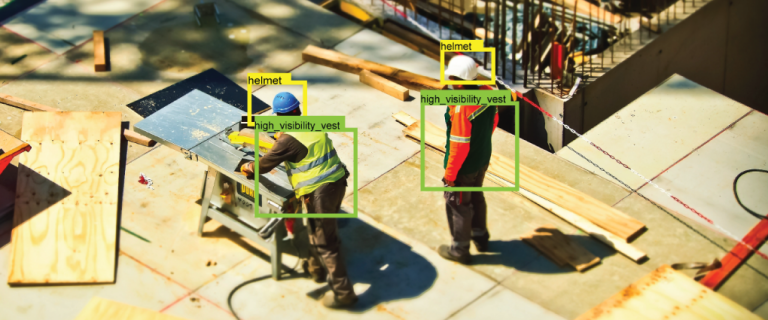
Computer vision takes a completely different approach. Instead of instrumenting each worker, it analyzes video feeds from cameras typically already installed on construction sites for security. AI algorithms process those feeds in real time, detecting whether workers are wearing required PPE – helmets, vests, gloves, goggles – and flagging violations as they happen.
In our PPE detection deployment for Mantinga, a food manufacturing company, the system achieved 93% accuracy detecting hardhats and safety vests. The approach worked because it leveraged existing camera infrastructure with no additional hardware per worker.
For construction specifically, we ran a 3-month pilot with Merko and Mitnija – two of the largest construction companies in the Baltic region. The system monitored PPE compliance across active construction sites using standard security cameras.
1
Near-zero cost per worker
Whether your site has 50 or 500 workers, the cost doesn’t scale proportionally. You pay for software and computing, not per-head hardware. For sites with high turnover, this advantage is significant.
2
No additional hardware on workers
Workers wear their standard PPE. No sensors to charge, no devices to track, no equipment to replace. This also eliminates worker resistance – nobody has to carry or wear anything new.
3
Built-in evidence for every violation
Every compliance violation comes with video footage – stored automatically. This matters for incident investigation, regulatory documentation, and resolving disputes about whether a breach actually occurred.
4
Multi-purpose platform
The same camera infrastructure that detects PPE can also monitor zone access, track equipment, measure productivity patterns, and detect unsafe behavior. Adding a new capability means training a new model, not installing new hardware.
5
Software updates, not hardware swaps
As detection models improve, you update the software. New PPE types, new scenarios, higher accuracy – all delivered through model updates rather than physical equipment changes.
We deploy these systems, so let us be direct about the limitations:
Computer vision cannot measure biometrics. It struggles with variable lighting, camera blind spots, and worker occlusion. Detection accuracy drops as distance increases or when workers overlap in the frame. And continuous video monitoring raises legitimate privacy concerns under GDPR and local labor regulations.
No biometric data. A camera can see that a worker is wearing a hardhat. It cannot tell you that the worker underneath it is dangerously dehydrated or showing signs of fatigue. If individual health monitoring is a priority, CV alone won’t solve it.
Lighting and environmental conditions. Construction sites have variable lighting – harsh sunlight, deep shadows, dust, rain. These affect camera performance and detection accuracy. Nighttime operations require infrared cameras or adequate artificial lighting. Our 93% accuracy figure was achieved under controlled conditions; real-world construction sites introduce variables that can push accuracy lower.
Camera blind spots. Cameras cover fixed areas. Workers move into spaces between camera zones, inside structures under construction, or behind equipment. Full coverage requires thoughtful camera placement, and even then, gaps exist. Unlike a wearable that follows the worker everywhere, a camera only sees what’s in its field of view.
Occlusion and distance. When workers are far from cameras, grouped closely together, or partially hidden behind objects, accuracy drops. Identifying which specific worker is non-compliant gets harder as distance increases.
Privacy considerations. Depending on jurisdiction, you may need to comply with GDPR, local labor regulations, or union agreements. Workers who feel surveilled rather than protected can disengage – damaging the safety culture the technology is meant to support. Clear communication about what’s being monitored and why is essential.
Where Both Systems Fall Short
Neither technology solves the fundamental human problem. A worker who deliberately removes their hardhat because it’s uncomfortable in 35 degrees heat will do it regardless of whether a camera or a sensor catches them. Technology catches violations. Culture prevents them.
Both systems also require ongoing maintenance and calibration. AI models need retraining as conditions change. Sensors need replacement. Cameras need cleaning and repositioning as the construction site evolves – and construction sites change constantly. The building that was an open structure last month is now enclosed, changing lighting and camera angles entirely.
Both systems face the “alarm fatigue” problem. Too many alerts – especially false positives – and supervisors start ignoring them. The system that cried wolf becomes background noise. Careful threshold tuning and alert prioritization are essential for either approach.
The Hybrid Approach: When It Makes Sense
For large-scale construction operations, the most effective approach often combines both technologies – using each where it’s strongest.
Computer vision handles site-wide PPE compliance monitoring, zone access control, and general safety behavior detection. It covers the broad picture cost-effectively because it scales with camera coverage rather than headcount.
Smart PPE supplements this for specific high-risk roles – workers in confined spaces, those exposed to hazardous substances, or workers in extreme temperature conditions where biometric monitoring can prevent health emergencies.
| Safety need | Best approach | Why |
|---|---|---|
| Site-wide PPE compliance | Computer Vision | Scales with cameras, not headcount |
| Heat stress / fatigue monitoring | Smart PPE | Requires biometric sensors cameras can’t provide |
| Zone access control | Computer Vision | Detects unauthorized entry without per-worker devices |
| Gas / chemical exposure | Smart PPE | Environmental sensors detect invisible hazards |
| Incident investigation | Computer Vision | Video evidence stored automatically |
| Confined space worker safety | Smart PPE | Follows the worker where cameras can’t reach |
This isn’t about choosing one or the other. It’s about understanding what each technology can and can’t see.
The practical reality: most construction companies start with computer vision because it leverages existing infrastructure, costs less to deploy, and covers the most common compliance monitoring needs. Smart PPE gets layered in for specific use cases where individual health data justifies the per-worker investment.
Our Recommendation
If you’re starting from zero and need to improve PPE compliance monitoring on construction sites, start with computer vision. The cost-to-coverage ratio is hard to beat. You’re working with infrastructure – security cameras – that likely already exists on your site. Deployment is measured in days or weeks, not months. And the system does more than just PPE: zone monitoring, equipment tracking, behavior analysis, and incident documentation all come from the same platform.
Smart PPE is a legitimate technology with real safety benefits, particularly for biometric monitoring. But the per-worker costs, connectivity requirements, and the need for supporting visual evidence mean it works best as a complement to camera-based monitoring rather than a standalone solution.
At Agmis, we’ve been deploying computer vision for construction safety across Baltic and EU markets for several years. If you’re evaluating options, we’re happy to walk through what we’ve learned – including what didn’t work.
Frequently Asked Questions
Get a clear path forward.
Share your challenge and walk away with concrete next steps - whether you're exploring AI, automating a process, or scoping a custom software project.
- Honest assessment of your situation - no sales pitch
- Actionable next steps you can use right away
- AI, automation, and custom software expertise