Construction sites have safety policies. They have protocols, training programs, and compliance officers. What they don’t have is the ability to watch every worker, on every level, at every moment of an eight-hour shift.
That gap – between policy and practice – is where accidents happen. Not because workers are reckless, but because human oversight has physical limits. A site manager can’t be in three places at once. By the time someone notices a missing hardhat, the moment of risk has already passed.
This post covers what we learned deploying computer vision for construction safety at two high-risk sites in Lithuania – what the technology actually does, what it took to get it working, and where it makes sense to invest. (For a broader look at how computer vision is being used across construction, we’ve covered that separately.)
Why PPE Compliance Is Harder Than It Looks
Every construction company has PPE requirements. Hardhats, high-visibility vests, safety goggles, proper footwear – the list is standard. The challenge isn’t defining the rules. It’s enforcing them consistently across a site where dozens or hundreds of workers move through different zones, shifts change, and subcontractors rotate in and out.
Site managers know this. They do walkthroughs. They issue reminders. They document violations when they catch them. But they also know how much they miss.
The math doesn’t work in their favor. A single safety officer covering a multi-level site with 80 workers can physically observe a fraction of the activity happening at any moment. Workers know this too – not because they want to cut corners, but because human attention is finite and predictable. Compliance tends to be highest when supervision is visible and drops when it isn’t.
The cost of that gap shows up in incident reports, project delays, regulatory fines, and insurance premiums. In serious cases, it shows up in ways that don’t fit on a spreadsheet at all.
What We Actually Deployed
We ran a three-month pilot at two leading Lithuanian construction companies: JSC Merko statyba and JSC Mitnija. Both were selected for their high-risk activities and willingness to test new safety approaches.
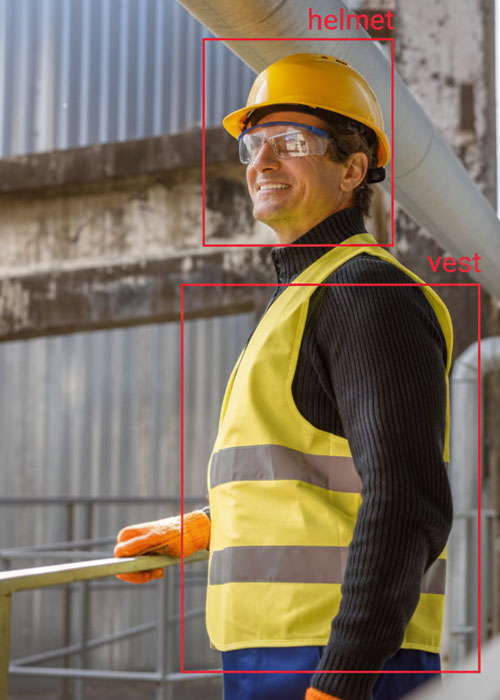
The system uses existing CCTV infrastructure – cameras already installed on site – combined with computer vision software that identifies PPE compliance in real time. It detects:
- Hardhats
- High-visibility vests
- Work goggles
- Safety footwear
- Protection belts for workers at height
When a worker enters a monitored zone without required equipment, the system flags it immediately. Site managers receive alerts – not at the end of the day in a report, but in the moment when intervention is still possible.
Every incident gets logged automatically: time, location, what was missing. That record becomes useful for identifying patterns – which zones have the most violations, which shifts, which types of equipment get skipped most often.
What the Pilot Showed
The results after three months:
Safety compliance increased. The number of non-compliance alerts declined over the pilot period, indicating that workers were wearing required PPE more consistently.
Response time improved. When violations occurred, site managers were able to act faster. The alert system meant issues were addressed in minutes rather than discovered hours later during a walkthrough.
Violations and minor incidents decreased. Preliminary data showed fewer safety violations and a reduction in minor accidents – suggesting the technology was having a real effect on site behavior.
Site teams found it usable. Feedback from safety managers was positive. The system integrated into their existing workflows without requiring significant process changes.
The Honest Assessment
Saulius Putrimas, CEO of JSC Merko statyba, summarized it directly: “The solution is not fully standardized and finalized. However, it has great potential.”
That’s an accurate description of where the technology sits. It works. It produces measurable results. It also requires ongoing refinement to handle the variability of real construction environments – weather, lighting changes, camera angles, the constant flux of a working site.
This isn’t a plug-and-play product. It’s a system that improves with tuning and feedback from the people using it.
What It Takes to Get There
The pilot wasn’t just software installation. Getting computer vision for construction safety working at a real site required several things that don’t show up in product demos.
Camera Placement and Infrastructure
The system runs on existing CCTV cameras, but camera positioning matters. Angles that work for general security surveillance don’t always work for PPE detection. Some cameras needed repositioning. Others needed better resolution or different mounting to capture the right zones.
Server infrastructure had to support the processing load. Real-time detection means real-time compute – the system can’t wait for overnight batch processing.
Training the People, Not Just the Model
Site safety managers and IT staff needed training on how to operate the system, interpret alerts, and respond appropriately. An alert is only useful if someone acts on it. That required building the system into existing safety workflows rather than treating it as a separate tool.
Defining What “Compliance” Means
This sounds obvious, but it’s not. Different zones have different requirements. A worker at ground level might not need a protection belt. A worker near heavy machinery might need goggles that aren’t required elsewhere. The system had to be configured to understand these distinctions – which required input from site safety teams who know their specific requirements.
Ongoing Adjustment
Construction sites change. Scaffolding goes up and comes down. Work zones shift. New subcontractors arrive with different equipment. A system that’s calibrated perfectly in month one will drift if it’s not monitored and adjusted over time. We’ve documented the practical realities of deploying PPE detection in more detail elsewhere.

See how Agmis deployed AI-powered PPE detection at Ignitis Kaunas CHP, enabling 24/7 workplace safety monitoring with instant violation alerts and automated compliance reporting.
When Does This Make Sense?
Computer vision for construction safety has the highest impact when certain conditions are present. It’s not the right investment for every site.
Strong Conditions
Large sites with multiple active zones. The more ground a site covers, the harder it is for human oversight to keep up. Automated monitoring scales in a way that adding safety officers doesn’t.
High worker turnover or multiple subcontractors. When the workforce changes frequently, consistent compliance culture is harder to maintain. New workers may not know the site-specific requirements. Subcontractors may have different standards. Continuous monitoring fills that gap.
High-risk activities. Work at height, heavy machinery operation, confined spaces. The higher the consequence of a safety failure, the more valuable real-time detection becomes.
Sites with existing CCTV infrastructure. If cameras are already in place, the incremental cost of adding computer vision is significantly lower than building monitoring infrastructure from scratch.
Weaker Conditions
Small crews with stable teams. A site with 10 workers who’ve worked together for years probably doesn’t need automated PPE monitoring. Human oversight is manageable at that scale, and compliance culture is already established.
Sites with minimal camera coverage. If you’d need to install a full CCTV system before the computer vision layer adds value, the total investment changes the ROI calculation substantially.
Low-risk environments. If the safety requirements are minimal and the consequences of violations are low, the investment may not be justified.
The honest conversation starts by assessing which category your site falls into – before anyone starts talking about implementation.
What Changes When Monitoring Becomes Continuous
The immediate benefit is catching violations faster. But the longer-term shift is more structural.
Manual safety enforcement is inherently reactive. Someone sees a violation, addresses it, moves on. There’s no systematic record of what’s being missed, where problems cluster, or whether compliance is improving over time.
Automated monitoring produces data. That data makes patterns visible:
- Which zones have the highest violation rates?
- Which shifts?
- Which types of PPE get skipped most often?
- Are violations increasing or decreasing over time?
That information feeds better decisions – about where to focus training, how to configure site layouts, which subcontractors need more oversight. It also creates documentation that matters for audits, insurance, and regulatory compliance.
There’s also a behavioral effect. When workers know monitoring is continuous, compliance becomes the default rather than something that happens when the safety officer is nearby. That’s not about surveillance for its own sake – it’s about making the safe choice the easy choice.
As one Agmis executive put it: “Accidents are never planned and happen in a matter of seconds.” Continuous monitoring compensates for the moments when human attention is elsewhere.
The Bottom Line
Computer vision for construction safety works. The pilot results at Merko statyba and Mitnija demonstrated measurable improvements in compliance, response time, and incident reduction.
It also requires investment – not just in technology, but in integration, training, and ongoing refinement. This isn’t a product you install and forget. It’s a system that improves as you feed it better data and tighter feedback from the people using it.
For sites where the conditions are right – large scale, high risk, variable workforce – the case is strong. For smaller operations with established safety cultures, the calculus is different.
The technology is ready. The question is whether your site is the right fit for it.
Get a clear path forward.
Share your challenge and walk away with concrete next steps - whether you're exploring AI, automating a process, or scoping a custom software project.
- Honest assessment of your situation - no sales pitch
- Actionable next steps you can use right away
- AI, automation, and custom software expertise