
How UAV Power Line Inspection Is Transforming Utility Maintenance

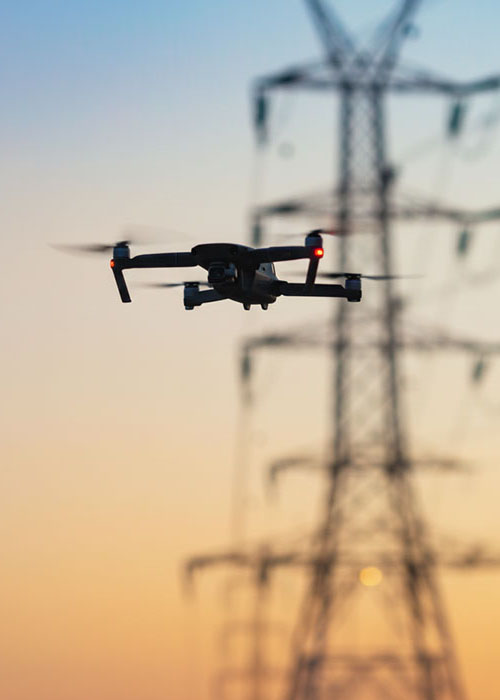
The energy sector is undergoing a quiet revolution. AI-powered UAV power line inspection is replacing decades-old methods, fundamentally shifting how utility companies manage infrastructure. At Agmis, we build the advanced computer vision and LiDAR analysis tools that turn raw drone data into proactive maintenance reports – helping utility operators detect defects faster, reduce operational costs, and keep their teams safer.
Table of Contents
The Problem with Traditional Power Grid Inspection
For generations, power grid inspection has followed the same basic pattern: send technicians into the field, have them climb poles or traverse difficult terrain, and document what they find. This approach comes with serious limitations.
Safety risks are significant. Technicians regularly work at height, navigate uneven ground, and operate near high-voltage equipment. Weather conditions can make already dangerous work even more hazardous.
Coverage is limited. A field team can only inspect so many poles in a day. With thousands of kilometers of power lines to maintain, comprehensive inspections become a years-long cycle rather than a regular occurrence.
Data quality varies. Human inspectors, no matter how experienced, can miss defects – especially subtle ones like hairline cracks in concrete or early-stage corrosion. Fatigue, weather, and access constraints all affect what gets documented.
Combining UAV Technology and AI for Smarter Inspections
UAVs capture the data, but AI-powered analysis is the true game-changer – moving beyond mere image collection to automated, actionable reporting.
Drone inspection addresses each of the traditional challenges head-on. UAVs capture high-resolution imagery and LiDAR data across vast stretches of infrastructure in a fraction of the time manual methods require. Our approach integrates multiple AI model types – segmentation, object detection, classification, and preprocessing – into a unified utility maintenance solution.
Rather than simply collecting images for human review, our system processes visual and LiDAR data to automatically detect infrastructure elements, identify defects, and generate maintenance reports. This combination of UAV technology and intelligent computer vision delivers defect detection accuracy that manual inspection simply cannot match.
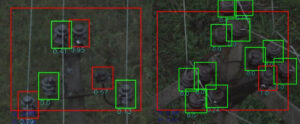
In real-world deployments, our AI models have achieved 96% average precision in detecting power grid infrastructure elements, 92% accuracy in classifying insulators as intact or broken, and 82% precision in categorizing crossarms into intact, tilted, and crooked states.
 Case Study

See how Agmis achieved 96% precision in power grid element detection for Lithuania's national energy distribution operator, processing 200,000 photos and 700km of LiDAR data.
What Defects Can AI-Powered Drone Inspection Detect?
Our computer vision models are trained on thousands of hours of real-world transmission line inspection data. They detect and classify a wide range of infrastructure issues.
Insulator defects include broken and contaminated glass insulators, as well as damaged porcelain insulators that can lead to flashovers and outages.
Structural issues cover wood pole cavities, cracks in concrete pillars, inclined poles, and bent or tilted crossarms that compromise grid stability.
Corrosion and wear shows up as rust on poles, bolts, and structural components – indicating maintenance needs before failure occurs.
Vegetation encroachment identifies where trees and brush grow too close to power lines, creating fire risks and potential service interruptions.
Each detected issue is documented with precise location data, severity classification, and supporting imagery – giving maintenance teams everything they need to prioritize and plan repairs.
LiDAR Analysis for Precision Measurements
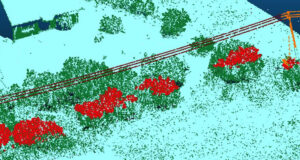
Beyond visual defect detection, LiDAR data enables measurements that would be impossible to gather manually at scale.
Our algorithms calculate pillar tilts to identify structural instability before it becomes critical. They measure the distance between the lowest wire point and the ground, ensuring clearance compliance. They assess distances to nearby structures like buildings and vegetation, flagging potential safety violations.
This combination of RGB imagery and LiDAR analysis – what we call data fusion – provides a complete picture of infrastructure health that no single data source could deliver alone.
Flexible Deployment Across Platforms
While UAV power line inspection forms the core of our solution, the underlying AI models work across multiple platforms. This flexibility means utility companies can deploy our technology without replacing their existing equipment.
Aerial platforms remain the primary use case, with drones capturing high-resolution imagery across transmission and distribution grid networks.
Ground vehicles equipped with cameras can perform continuous inspection of substations and distribution networks, particularly in areas where drone flight is restricted.
Stationary cameras positioned at critical points along the grid enable real-time monitoring of high-risk locations.
This platform-agnostic approach to software development makes our solution practical for utility companies at any scale- from regional operators to national grid managers.
The Business Case for AI-Powered Inspection
Adopting UAV power line inspection delivers measurable operational improvements.
Inspection speed increases dramatically. What once took weeks of field work can now be completed in days. Faster inspection cycles mean issues are identified sooner, reducing the risk of equipment failure and service interruptions.
Operational costs decrease. AI-driven analysis reduces reliance on large inspection teams and minimizes the expensive, time-consuming process of manual data review. Resources shift from inspection overhead to actual maintenance work.
Defect detection becomes consistent. Comprehensive coverage eliminates the gaps and inconsistencies inherent in manual inspection. Every pole, every insulator, every crossarm receives the same level of scrutiny.
Proactive maintenance becomes possible. With detailed defect data and trend analysis, utility companies can shift from reactive repairs to planned maintenance – extending equipment life and reducing emergency response costs.
Who Benefits from This Technology?
The applications extend across the energy sector and beyond.
Utility companies of all sizes can optimize their inspection processes while maintaining safety and reliability standards. Energy providers reduce downtime and ensure consistent service delivery through more effective grid monitoring. Infrastructure developers incorporate AI inspection into new projects, ensuring grid reliability from day one. Government agencies responsible for utility regulation can enforce safety standards more effectively with comprehensive inspection data.
Getting Started
Implementing UAV power line inspection with Agmis is straightforward. Our team handles the complexity of AI model deployment and integration, delivering a solution that works with your existing workflows and data infrastructure.
The process begins with data capture – either through your existing UAV fleet or through aerial inspection partners. Our AI analyzes the imagery and LiDAR data, and you receive comprehensive defect reports with actionable recommendations.
No massive infrastructure investment. No lengthy implementation timeline. Just better inspection data, delivered faster.
UAV power line inspection represents more than technological progress – it’s a strategic upgrade for utility operations. With AI-powered computer vision technology, companies can reduce operational costs, improve defect detection accuracy, and build safer, more resilient energy networks.
Ready to transform your power grid inspection processes? Contact our team to discuss how Agmis can address your specific infrastructure challenges.