
AI Quality Control in Manufacturing: The Path to 99% Defect Detection

Your best inspector misses defects. Not because they’re careless – because they’re human.
After four hours on a production line, even the most experienced quality control specialist starts to fatigue. Their eyes blur. Their attention drifts. And somewhere between unit 847 and unit 848, a defect slips through.
This isn’t a training problem. It’s a biology problem. And it’s costing manufacturers millions in recalls, rework, and reputation damage every year.
The solution isn’t hiring more inspectors or demanding more focus. It’s augmenting human judgment with AI systems that never get tired, never lose concentration, and can reach accuracy levels that manual inspection simply cannot match – in some cases, up to 99%.
Explore what AI quality control actually looks like in production – its real capabilities, its limitations, and how to implement it without disrupting your operations.
Table of Contents
The Quality Control Paradox
Here’s the uncomfortable truth that quality managers rarely discuss openly: 100% inspection is mathematically impossible with human inspectors.
Consider the numbers. A typical manufacturing line produces thousands of units per shift. Each unit might have dozens of potential defect points. A human inspector has roughly 2-3 seconds to evaluate each unit before the next one arrives.
Even with perfect training and ideal conditions, human inspection accuracy tops out around 80-85%. That sounds acceptable – until you calculate what it means at scale.
The Hidden Cost of “Good Enough” Inspection
At 85% detection accuracy across 10,000 daily units with a 2% defect rate:
- 200 defective units produced daily
- 170 caught by inspection
- 30 defective units shipped to customers – every single day
Over a year, that’s nearly 11,000 defective products reaching the market. Each one represents a potential warranty claim, customer complaint, or worse – a safety incident.
But here’s the paradox: improving human inspection is incredibly expensive and yields diminishing returns.
Adding a second inspector doesn’t double your detection rate – it might improve it by 5-10%. Adding a third inspector adds cost without proportional quality gains. You’re fighting biology with headcount, and biology always wins.
Why Human Inspection Plateaus
Human inspectors face three fundamental limitations:
Fatigue degradation. Studies in ergonomics suggest that inspection accuracy can degrade by 20 – 30% after just an hour of continuous monitoring. The longer the shift, the more defects slip through.
Inconsistency between inspectors. What one inspector calls a defect, another might pass. This variability creates quality drift that’s nearly impossible to calibrate away.
Speed-accuracy tradeoff. Push inspectors to work faster, and accuracy drops. Demand higher accuracy, and throughput suffers. There’s no winning configuration.
The quality control paradox is this: the more you need inspection, the less reliable human inspection becomes.
How AI Changes the Equation
Computer vision for quality control doesn’t replace human judgment – it removes human limitations from the equation.
An AI-powered inspection system processes every unit with identical attention, whether it’s the first unit of the morning or the ten-thousandth unit of a triple shift. It doesn’t get tired. It doesn’t get distracted. And it learns from every defect it encounters.
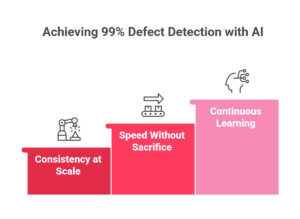
Consistency at Scale
Where human accuracy degrades over time, AI accuracy remains constant – or improves.
A properly trained AI model delivers the same detection performance at 3 AM as it does at 9 AM. The same performance on Friday afternoon as Monday morning. The same performance whether the operator is having a good day or a terrible one.
This consistency compounds. Over thousands of units, the gap between AI and human inspection widens dramatically. What looks like a small accuracy improvement (say, 85% to 99%) actually represents an order-of-magnitude reduction in escaped defects.
Speed Without Sacrifice
Traditional inspection forces a tradeoff: faster throughput means lower accuracy. AI eliminates this constraint.
Modern AI defect detection systems process images in milliseconds – fast enough to inspect every unit on even the fastest production lines without creating bottlenecks. In our automotive seat inspection implementation, AI inspection proved 27 times faster than human inspection while simultaneously improving accuracy.
That’s not a tradeoff. That’s a transformation.
Continuous Learning
Perhaps most importantly, AI quality systems improve over time.
Every defect the system encounters – whether caught correctly or flagged for human review – becomes training data. Edge cases that initially confuse the model become recognized patterns. The system gets smarter with use, while human inspection stays static (or degrades).
This creates a compounding advantage. Companies that implement AI quality control today don’t just gain immediate benefits – they’re building a detection capability that improves every month.
What AI Quality Control Can Detect
Let’s be direct about capabilities. AI quality control isn’t magic, and overselling it does everyone a disservice. Here’s an honest assessment of what’s reliably detectable today.
What AI Detects Well
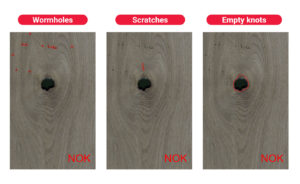
Surface defects. Scratches, dents, chips, cracks, and discoloration are ideal candidates for AI detection. These visual anomalies create clear patterns that computer vision identifies with high accuracy. Our automotive seat system achieves 99% accuracy on surface imperfections including subtle wrinkles that human inspectors frequently miss.
Dimensional variations. With proper camera setup and calibration, AI systems detect size, shape, and position deviations that fall outside acceptable tolerances. This works particularly well for consistent product types where the “correct” dimensions are clearly defined.
Assembly completeness. Missing components, incorrect orientations, and improper assembly sequences are straightforward for AI to identify. The system compares each unit against a known-good reference and flags deviations.
Contamination and foreign objects. Particles, debris, or incorrect materials that shouldn’t be present create visual signatures that AI detects reliably. This is especially valuable in food manufacturing and pharmaceutical production.
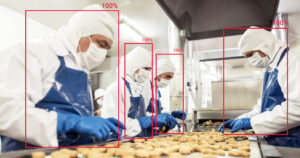
PPE and safety compliance. Beyond product quality, AI-powered detection systems monitor worker safety compliance, identifying missing helmets, vests, face masks, and other protective equipment with accuracy rates exceeding 93%.
What Requires Careful Implementation
Highly variable products. When “acceptable” appearance varies significantly between units (natural materials, artistic products), defining what constitutes a defect becomes challenging. These implementations require more sophisticated training and often human-in-the-loop validation.
Subsurface defects. Standard visual inspection can’t see inside materials. Detecting internal cracks or structural weaknesses requires specialized imaging (X-ray, ultrasound) combined with AI analysis – possible, but more complex than surface inspection.
Contextual quality. Some defects only matter in specific contexts. A minor scratch on a hidden surface might be acceptable; the same scratch on a visible surface might not. Teaching AI this contextual judgment requires careful training data curation.
Implementation Reality Check
The gap between AI demos and production deployment is where many projects fail. Here’s what actually matters for successful implementation.
Camera and Lighting Requirements
AI sees what cameras capture. Poor imaging produces poor results – no algorithm can overcome fundamentally bad input data.
Camera considerations:
- Resolution must match your smallest relevant defect size
- Frame rate must exceed your line speed
- Positioning must capture all critical inspection surfaces
- Industrial-grade hardware handles manufacturing environment conditions
Lighting is often more important than cameras:
- Consistent, controlled lighting eliminates variable shadows
- Specific lighting angles reveal surface defects that ambient light hides
- Ring lights, backlighting, and structured light each suit different defect types
- Lighting failures should trigger immediate alerts
Most failed AI quality implementations trace back to inadequate imaging infrastructure, not AI limitations.
Training Data: Less Than You Think
Here’s where conventional wisdom misleads: you don’t need thousands of images to train effective defect detection.
Modern AI architectures like YOLO and Vision Transformers come pre-trained on millions of images. They already understand visual concepts – edges, textures, shapes, colors. Training for your specific application is fine-tuning, not starting from scratch.
With the right approach, you can train production-ready detection models with approximately 100 labeled images. The key requirements:
- Images captured in your actual production environment
- Representative examples of both acceptable and defective units
- Clear annotations marking defect locations
- Coverage of lighting variations and edge cases
This dramatically accelerates deployment timelines. Instead of months of data collection, you can move from concept to prototype in days.
Integration With Production Lines
Even the most accurate AI model delivers no value if it can’t operate smoothly inside your production environment.
Successful AI quality control systems are designed to work as part of the production line – not as standalone tools. Key integration points to plan early include:
- Cameras triggered in sync with production flow, so every product is inspected at the right moment
- Reliable communication with existing automation systems, ensuring inspection results can trigger actions immediately
- Clear reject or alert mechanisms, such as automated removal, line stops, or operator notifications
- Data capture and reporting, so inspection results feed into quality systems and production analytics
- User-friendly dashboards, giving operators and managers real-time visibility into quality performance
The most effective implementations plan this integration before training AI models. Your production setup – line speed, layout, environment, and control systems – should guide camera placement, hardware choices, and overall system design from day one.
The Path to Production
Implementing AI-driven defect detection follows a logical progression. How fast you move through each stage depends on your starting point – not on arbitrary timelines.
Phase 1: Assessment – Define the problem clearly. Which defects truly matter? What level of accuracy makes financial sense? Where do delays, waste, or rework occur today? Clear answers here prevent expensive rework later.
Phase 2: Pilot Setup – Install cameras and begin collecting real production data. This phase moves quickly if you already have suitable imaging in place. It takes longer when starting from scratch or working in challenging conditions like dust, vibration, or inconsistent lighting.
Phase 3: Model Training – Train and validate the AI on your actual products and defects. With modern computer vision techniques, this stage is often faster than expected – assuming good-quality data from the pilot phase.
Phase 4: Integration – Connect inspection results to production actions: automatic rejection, alerts, and data logging. The complexity here depends largely on your existing automation systems. Modern equipment simplifies integration; older systems require more customization.
Phase 5: Validation – Run the AI system alongside your current inspection process. Compare results, identify edge cases, and refine performance until you’re confident in full production use.
What Determines Your Speed
The factors that actually drive implementation pace:
Rather than guess at timelines, start a conversation about your specific situation. We’ll assess your readiness factors and give you an honest view of what implementation looks like for your operation.
→ Want to see how AI inspection could work for your operation?
Talk to an expert
Case Study: Automotive Seat Defect Detection
Abstract capabilities matter less than proven results. Here’s how AI quality control performed in actual manufacturing production.
The Challenge
A leading automotive seat manufacturer faced a quality control bottleneck that constrained their entire operation.
Car seat production requires detecting subtle defects – wrinkles, surface imperfections, material flaws – across more than 40 unique seat models. Each model features different textures, colors, and finishes. Human inspectors struggled to maintain consistency across this variation.
The consequences were significant:
- Inspection created production bottlenecks
- Quality inconsistency led to customer complaints
- Manual inspection costs consumed quality budget
- Defect escapes threatened OEM relationships
Traditional approaches – more inspectors, additional training, slower line speeds – offered incremental improvement at substantial cost. They needed a fundamentally different approach.
Our Approach
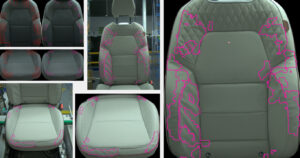
We implemented Seat Checker, an AI-powered defect detection solution built specifically for automotive seat inspection.
The technical approach:
- Deep learning algorithms trained to recognize surface imperfections across varied materials
- Self-learning system that adapts to different textures and finishes
- Integration with existing production line cameras and systems
- Real-time processing fast enough to match line speeds
The system learned what “acceptable” looks like for each seat model, then flagged deviations that indicated quality issues – whether obvious defects or subtle wrinkles that human inspectors frequently missed.
Results Achieved
The implementation delivered results that transformed their quality operation:
Beyond the headline numbers, the system enabled:
- Consistent quality across all 40+ seat models
- 24/7 inspection capability without staffing constraints
- Quality data capture for continuous improvement analysis
- Reduced customer complaints and warranty claims
The 27x speed improvement didn’t come at accuracy’s expense – it accompanied a significant accuracy gain. That’s the AI quality control value proposition: faster AND better, not faster OR better.
Lessons Learned
Key insights from this implementation:
Start with clear success criteria. Define what accuracy, speed, and integration requirements matter before implementation. This focuses development and enables objective evaluation.
Invest in imaging infrastructure. The cameras and lighting upgrades required upfront investment, but they determined system ceiling performance. Skimping here limits everything downstream.
Plan for model evolution. As the manufacturer introduced new seat models, the AI system required updates. Building model retraining into ongoing operations prevented capability degradation.
Human oversight remains valuable. The AI handles detection; humans handle edge cases and root cause analysis. The best results come from human-AI collaboration, not full automation.
Calculating Your ROI
AI quality control isn’t a cost center – it’s an investment with measurable returns. But generic ROI examples don’t help you make a real decision. Your operation has specific costs, defect rates, and production volumes that determine actual payback.
Here’s how to calculate ROI for your situation.
Direct Cost Savings
1. Inspection Labor Optimization
What you need to know:
- Current inspection headcount (FTEs dedicated to quality inspection)
- Fully burdened labor cost per inspector (salary + benefits + overhead)
- Realistic automation percentage (what portion of inspection can AI handle?)
Your calculation: Current inspection labor cost × Expected reduction percentage = Annual labor savings
AI inspection typically handles the repetitive, high-volume detection work while humans focus on edge cases, root cause analysis, and process improvement. The split varies by defect complexity and product variability.
2. Defect Escape Reduction
What you need to know:
- Current defect escape rate (what percentage of defects reach customers?)
- Annual production volume
- True cost per escaped defect (warranty claims + rework + customer impact + reputation damage)
Your calculation: (Annual escaped defects × Cost per escaped defect) × Expected reduction percentage = Escape cost savings
This is often the largest ROI driver – and the most underestimated. Companies frequently calculate only direct warranty costs while ignoring customer churn, expedited shipping for replacements, and engineering time spent on failure analysis.
Key Insight
Direct cost savings are easy to calculate – but indirect value often delivers 2-3x the total ROI. Don’t stop at labor and defect costs.
Indirect Value (Harder to Quantify, Often Larger)
Throughput improvement. If inspection creates production bottlenecks, faster AI inspection increases overall output capacity. What’s the revenue value of that additional capacity?
Quality consistency. Reduced variability improves customer satisfaction and protects OEM relationships. What would losing a key customer cost? What’s the value of avoiding that risk?
Continuous improvement enablement. AI systems capture defect data that manual inspection doesn’t – defect types, frequencies, patterns, correlations with production variables. This data fuels process improvements that compound over time.
The Numbers We Can Share
We can’t fabricate an ROI example that matches your situation. But we can share what we’ve measured in actual implementations:
- 27x faster inspection compared to manual processes
- 30x cost improvement in inspection operations
- 99% detection accuracy on surface defects
- 93%+ accuracy on PPE compliance detection
These results translate to substantial ROI – but the specific dollar value depends entirely on your current costs, defect rates, and production volumes.
Let’s Run Your Numbers
The most valuable conversation isn’t about generic examples – it’s about your specific operation.
Contact us with your current inspection costs and defect escape estimates. We’ll help you build a realistic ROI model based on what AI quality control could actually deliver in your environment – no inflated projections, just honest math.
Getting Started: The Pilot Approach
Full production deployment is the goal, but pilots prove value and reduce risk. Here’s the recommended approach.
Phase 1: Assessment
Define the inspection challenge:
- Which defects matter most?
- What’s your current detection rate?
- Where do inspection bottlenecks occur?
- What does success look like?
Evaluate technical requirements:
- Can existing cameras support AI inspection?
- What lighting modifications are needed?
- How will the system integrate with production controls?
- What accuracy threshold justifies deployment?
Pro Tip
Start your assessment with defects that cost the most – not the ones that happen most often. High-frequency, low-impact defects can wait.
Phase 2: Pilot Implementation
Start narrow:
- Select one product line or defect type
- Install dedicated imaging equipment
- Collect training data from your environment
- Train initial detection model
Validate in parallel:
- Run AI inspection alongside existing process
- Compare AI decisions against human decisions
- Measure accuracy, speed, and reliability
- Identify edge cases and failure modes
Phase 3: Refinement and Expansion
Optimize based on pilot data:
- Retrain model with edge cases
- Adjust imaging or lighting as needed
- Refine integration points
- Update operating procedures
Expand to additional applications:
- Additional product lines
- Additional defect types
- Additional production locations
The pilot approach de-risks investment while building internal expertise and stakeholder confidence.
The Competitive Reality
Computer vision quality control is becoming a competitive differentiator, not a nice-to-have capability.
Manufacturers implementing AI inspection gain advantages that compound over time: lower defect rates, reduced quality costs, faster throughput, and continuous improvement through data capture. Those advantages translate directly to customer satisfaction, margin improvement, and market position.
Manufacturers who wait face a widening gap. While competitors optimize, late adopters continue fighting the quality control paradox with approaches that can’t win.
The technology is mature. The ROI is proven. The question isn’t whether AI quality control works – it’s whether you’ll implement it before your competitors do.
Next Steps
AI-powered quality control isn’t theoretical – it’s deployed in production across automotive, food manufacturing, electronics, and dozens of other industries.
If you’re evaluating AI defect detection for your operation, start with a focused assessment:
- What are your highest-value inspection challenges?
- What would 99% detection accuracy mean for your quality metrics?
- What ROI would justify pilot investment?
Contact our team for assessment of your quality control challenges. We’ll evaluate your specific situation and provide honest recommendations – including whether AI inspection is the right solution for your needs.
Stop accepting the quality control paradox. Start building inspection capability that improves with every unit produced.