The “retail apocalypse” narrative has been running for years now. Big-box chains shuttering locations, department stores filing for bankruptcy, empty storefronts lining suburban strip malls. You’ve heard the story – physical retail is dying, and e-commerce is the inevitable future.
Except the numbers tell a different story entirely.
Despite the explosive growth of online shopping, physical stores still account for the vast majority of retail sales. And here’s what’s interesting: even the company that supposedly killed brick and mortar – Amazon – has been aggressively expanding into physical retail spaces. Their cashier-less Go stores, powered entirely by computer vision in retail technology, aren’t a retreat from their digital roots. They’re a glimpse at where shopping is headed.
McKinsey has noticed too. The consultancy giant now operates retail innovation labs inside US department stores, helping clients experiment with emerging technologies before rolling them out at scale.
The message is clear: physical retail isn’t dying. It’s evolving. And computer vision is at the center of that transformation.
Here’s how smart retailers are using these technologies to not just survive, but thrive.
Turning Security Cameras Into Business Intelligence
For years, e-commerce had an unfair advantage: data. Online retailers could track everything – where visitors came from, how long they lingered on a product page, what they almost bought but abandoned, what items they viewed together. This granular insight powered personalization, optimized layouts, and drove conversion rates through the roof.
Physical stores? They had foot traffic counters at the door and sales receipts. That was about it.
Computer vision in retail has leveled this playing field entirely.
Those security cameras already mounted throughout your store? They can now do far more than deter shoplifters. Modern computer vision platforms analyze that footage in real-time, extracting insights that would make any e-commerce analyst jealous:
- Traffic flow mapping shows exactly how customers move through your space – which aisles they browse, which displays they ignore, where bottlenecks form
- Dwell time analysis reveals which products actually capture attention versus which ones customers walk past without a second glance
- Demographic segmentation helps you understand who’s shopping when, enabling smarter staffing and targeted promotions
- Time-based patterns identify your true peak hours, not when you think you’re busy, but when you actually are
But here’s where physical retail gains an edge that online stores simply cannot match: emotional context.
Computer vision can read facial expressions. Did that new window display make someone stop and smile? Did the customer look confused trying to find something? Was there genuine excitement when they spotted a sale sign?
E-commerce can measure clicks and scroll depth. Physical retail can now measure human reactions. That’s a profound difference for understanding what actually drives purchasing decisions.
The End of the Checkout Line
Remember when self-service grocery stores were revolutionary? Before them, you’d walk up to a counter, tell the shopkeeper what you wanted, and wait while they gathered your items. The ability to browse and select products yourself was genuinely transformative.
We’re on the cusp of another shift just as significant: eliminating checkout entirely.
Amazon Go stores demonstrated the concept. Walk in, grab what you need, walk out. Cameras and sensors track what you take, and your account gets charged automatically. No scanning, no waiting, no friction.
The technology behind this isn’t science fiction – it’s computer vision in retail operating at scale. Cameras identify products as customers pick them up. The system tracks who took what. When you leave, you’re billed automatically.
Now, let’s be realistic. This technology isn’t ready to power a sprawling hypermarket with 50,000 SKUs and hundreds of simultaneous shoppers. The computational complexity scales dramatically with store size.
But smaller format stores? Convenience shops, grab-and-go cafeterias, airport kiosks? These are viable right now. And the technology improves constantly. What seems like a distant future for large retailers might arrive faster than most expect.
As a side benefit, the same visual recognition systems that enable cashier-less checkout also excel at detecting suspicious behavior. Shoplifting patterns, unusual movements, concealment attempts – computer vision spots these far more consistently than human observers who get tired, distracted, or simply can’t watch everywhere at once.
Smarter Queues, Happier Customers
Until cashier-less stores become widespread, retailers still need to manage the traditional checkout experience. And nothing kills a shopping trip faster than a long line.
This is where computer vision in retail delivers immediate, measurable ROI.
Consider what a queue management system can actually detect: current line lengths at each register, average wait times throughout the day, patterns in how queues build (they rarely grow linearly – they spike), and early warning signs that a backup is forming before customers start getting frustrated.
Armed with this data, store managers can make proactive decisions. Open another register before the line gets too long. Shift staff from stocking to checkout during predicted rush periods. Identify which cashiers process transactions fastest and learn from their techniques.
Real results from real deployments: Agmis conducted a two-month trial at two locations for one of Central and Eastern Europe’s largest retailers – stores that already had highly efficient queue management practices in place. The goal wasn’t to fix a broken system; it was to see if AI could tune an already-good operation toward perfection.
The results exceeded expectations. Cashier idle time dropped by 57.66%, recovering more than 2.5 person-hours per store per day. The system prevented 237 queue-forming incidents, saving customers an average of 2.25 hours of collective wait time daily.
That’s not theoretical efficiency – it’s documented productivity gains at scale.
Beyond queue management, computer vision also enables objective measurement of floor staff performance. The system can identify when a customer appears to need assistance (looking around, lingering uncertainly, examining products closely), track how quickly an associate responds, measure interaction duration, and correlate those interactions with subsequent purchases.
This isn’t about surveillance for surveillance’s sake. It’s about understanding what good service looks like in concrete, measurable terms – and then replicating it consistently.
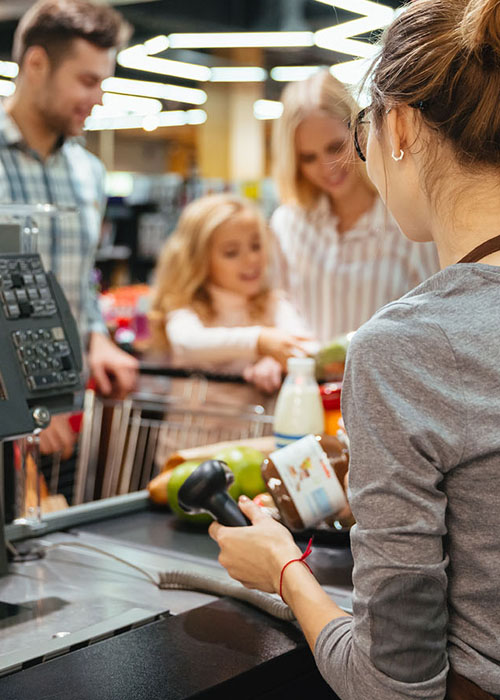
See how Agmis deployed computer vision queue management at one of Central and Eastern Europe's largest retailers, using existing security cameras to predict and prevent queue formation.
Shelves That Manage Themselves
Here’s a mundane but costly problem in physical retail: empty shelves. A customer wants to buy something, it’s supposedly in stock according to your inventory system, but the actual shelf is bare. Sale lost. Customer frustrated. Problem invisible until someone happens to notice.
Traditional inventory management tracks what’s in the building. Computer vision in retail tracks what’s actually on the shelf.
Cameras monitoring shelf space can detect when stock runs low and trigger restocking alerts before customers encounter empty spaces. In grocery retail especially, where margins are thin and every inch of shelf space represents revenue potential, this visibility is transformative.
The technology extends to pricing accuracy as well. Promotional prices get entered into the system, but did someone actually update the physical shelf tags? Computer vision can verify that the price displayed to customers matches what’s in your POS system – catching discrepancies that would otherwise lead to checkout conflicts, customer complaints, or margin erosion.
These aren’t glamorous applications. They won’t make headlines like cashier-less stores. But they represent the kind of operational excellence that separates profitable retailers from struggling ones.
The Bigger Picture
What connects all these applications -visitor analytics, automated checkout, queue optimization, inventory monitoring – is a fundamental shift in how physical retail operates.
For decades, brick and mortar stores were essentially blind. Managers relied on intuition, periodic reports, and anecdotal observation. Digital retailers, meanwhile, operated with real-time dashboards showing exactly what was happening across their entire operation.
Computer vision in retail closes that gap. Physical stores can now see their operations with the same clarity that e-commerce platforms have always enjoyed – and in some ways, with even greater depth, because cameras capture dimensions of human behavior that clicks never could.
The retailers who thrive in the coming years won’t be the ones who ignore technology or the ones who abandon physical stores for digital-only models. They’ll be the ones who blend both worlds: the convenience and data-richness of digital commerce with the tactile, immediate, human experience of physical shopping.
Computer vision is the bridge that makes that possible.
Get a clear path forward.
Share your challenge and walk away with concrete next steps - whether you're exploring AI, automating a process, or scoping a custom software project.
- Honest assessment of your situation - no sales pitch
- Actionable next steps you can use right away
- AI, automation, and custom software expertise