
MLOps Implementation for a Grid Intelligence Startup
Building Scalable ML Infrastructure for Next-Gen Grid Intelligence
How Agmis partnered with a grid intelligence startup to transform their machine learning operations from notebook-based experimentation to a production-grade, cost-efficient MLOps practice powering utility infrastructure assessment at scale.
A Grid Intelligence Pioneer Transforming Utility Infrastructure
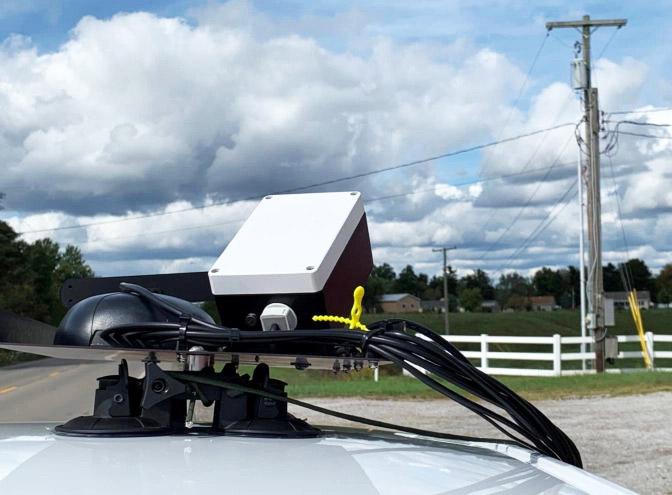
Founded in 2020 with $6M in venture capital, this grid intelligence startup has carved out a distinctive position in utility infrastructure assessment. Their approach: autonomous AI systems mounted on fleet vehicles, scanning and evaluating power grid assets at scale. To date, they've assessed over 500,000 poles for major utility companies including First Energy, Constellation Energy, and Alabama Power-pushing the boundaries of what AI can do for utility management.
Rapid Growth Exposed Cracks in ML Infrastructure
Inefficient Training Processes
Model development lived primarily in Jupyter notebooks - an approach lacking the structure needed for reproducibility, driving up operational costs as the team scaled.
Data Handling Gaps
Managing massive datasets while deploying models into dynamic, real-world environments proved difficult. The gap between "model works in a notebook" and "model works on a truck" was widening.
Monitoring Blind Spots
Once models were deployed, visibility dropped. No robust system existed for tracking production performance or identifying when models needed retraining.
Scaling Friction
What worked in early days was creating friction. Ad-hoc training runs and disconnected workflows couldn't support the company's ambitious growth trajectory.
Custom MLOps Strategy for Production-Grade Operations
AWS SageMaker Migration: Moved model training off Jupyter notebooks onto dedicated SageMaker infrastructure, cutting costs and introducing the systematization that production ML demands.
Database-Integrated Training: Every training run now logs its full context to RedShift-model settings, code versions, dataset information, resulting metrics, and model weights. Nothing gets lost. Everything is reproducible.
Weights & Biases Integration: Implemented and customized W&B for experiment tracking. Teams can now visualize training progress and key metrics without needing direct access to training machines.
Best Practices & Data Synthesis: Shared hard-won knowledge on data integrity, error analysis, and synthesizing defective data from non-defective samples to improve model robustness.
Embedded Collaboration: Started by working closely with leadership-PM, CEO, and data scientist - then integrated directly with the ML team, aligning on approaches task by task.
Production Cost Optimization: Optimized how models are invoked in production, reducing ongoing operational expenses beyond just the training infrastructure improvements.
Deep Partnership
Invested in ground-up transformation of ML infrastructure-and counting
Concrete Results Across ML Operations
Significant Cost Reduction
Moving training to purpose-built infrastructure lowered compute costs. Production invocation optimizations further reduced ongoing operational expenses.
Process Systematization
ML workflows became repeatable and auditable. From training best practices to model tracking and management, the entire pipeline gained structure.
Knowledge Transfer
This wasn't a handoff-it was a partnership. The client's team absorbed new methodologies and expertise, building internal capability that persists beyond our engagement.
Production-Grade Pipeline
From notebook-based experimentation to systematized, production-grade MLOps practice-ready to support continued growth and innovation.
Training Infrastructure Transformation
The move from ad-hoc Jupyter notebooks to AWS SageMaker fundamentally changed how models are developed. Training runs that were once somewhat random experiments became structured, cost-efficient operations with clear inputs and outputs.
Complete Reproducibility
Every training run's full context-model settings, code versions, dataset information, metrics, and weights-is now logged to RedShift. This eliminates the "it worked on my machine" problem and creates a complete audit trail for any model in production.
Real-Time Experiment Visibility
With Weights & Biases integration, team members can visualize training progress and key metrics without needing direct access to training machines. This democratized visibility accelerates iteration cycles and improves collaboration.
Sustainable Internal Capability
Beyond tooling and infrastructure, the engagement transferred deep ML operations expertise to the client's team. They now have the knowledge, processes, and confidence to continue evolving their ML practice independently.
Setting New Standards for ML-Driven Startups
Startups building with machine learning face a specific tension: move fast, but also build systems that don't collapse under their own weight as you scale. MLOps bridges that gap—connecting model development to operational deployment while ensuring sustainable growth.
Scalability for Growth
For resource-constrained teams, MLOps provides structure without bureaucracy. It keeps models accurate, relevant, and manageable-even as data volumes explode and use cases multiply.
Operational Discipline
MLOps embeds continuous improvement, automation, and disciplined experimentation into how teams work. That mindset is often the difference between startups that scale and those that stall.
Cultural Transformation
Beyond technical improvements, proper MLOps practice changes how teams think about model development-shifting from heroic individual efforts to sustainable, collaborative processes.
Foundation for Innovation
The work didn't just solve immediate problems. It built the foundation for continued innovation in grid intelligence-giving the team tools, processes, and knowledge to keep pushing forward.