
Furniture Board Surface Quality Inspection with Computer Vision
Furniture Board Surface Quality Inspection with Computer Vision
Agmis developed an automated visual inspection system for furniture manufacturing that scans every board in real-time, detects drilling and milling defects, and compares results against CAD specifications-reducing defect rates to near zero.
Precision Failures Cost More Than Materials
In furniture manufacturing, precision is everything. A single missed hole or misaligned cut can render an entire product unusable-discovered only when the customer attempts assembly. Manufacturers face persistent quality challenges:
Equipment Wear and Calibration Drift
Drill bits break, dull, or lose calibration due to vibration. This results in incorrectly drilled holes, shifted positions, or flawed milling trajectories that compound across production runs.
Missed Operations
Technical glitches cause machinery to skip programmed operations entirely. A board missing several holes appears identical to a correct one-until assembly fails.
Manual Inspection Gaps
Traditional quality control relies on workers spot-checking a fraction of output. Defective boards slip through to packaging undetected, reaching customers before problems surface.
Compounding Costs
Every returned defective product carries material costs, logistics expenses, replacement manufacturing time, and reputational damage that erodes customer trust.
Computer Vision Quality Control Integrated into Production Lines
Agmis delivers flexible computer vision platforms that integrate directly into furniture manufacturing lines. Our system inspects every board without slowing production-catching defects the moment they occur.
Real-Time Conveyor Scanning: Industrial cameras capture high-resolution images of every board passing on the conveyor. No stopping, no sampling-complete inspection coverage at full production speed.
Intelligent Element Recognition: Computer vision algorithms identify all critical features - drilled holes, milling locations, edge lamination, surface texture, and material orientation - achieving a precision of 0.3 mm. The system understands exactly what each board should contain and ensures every element is positioned with industrial-grade accuracy.
Automated CAD Comparison: Each captured image is instantly compared against the original digital product model. The system knows exactly where every hole, cut, and feature should appear-and flags any deviation.
Immediate Defect Response: When the system detects a missing hole, misaligned drilling, surface defect, or any specification deviation, it instantly alerts operators or automatically diverts the board for manual review.
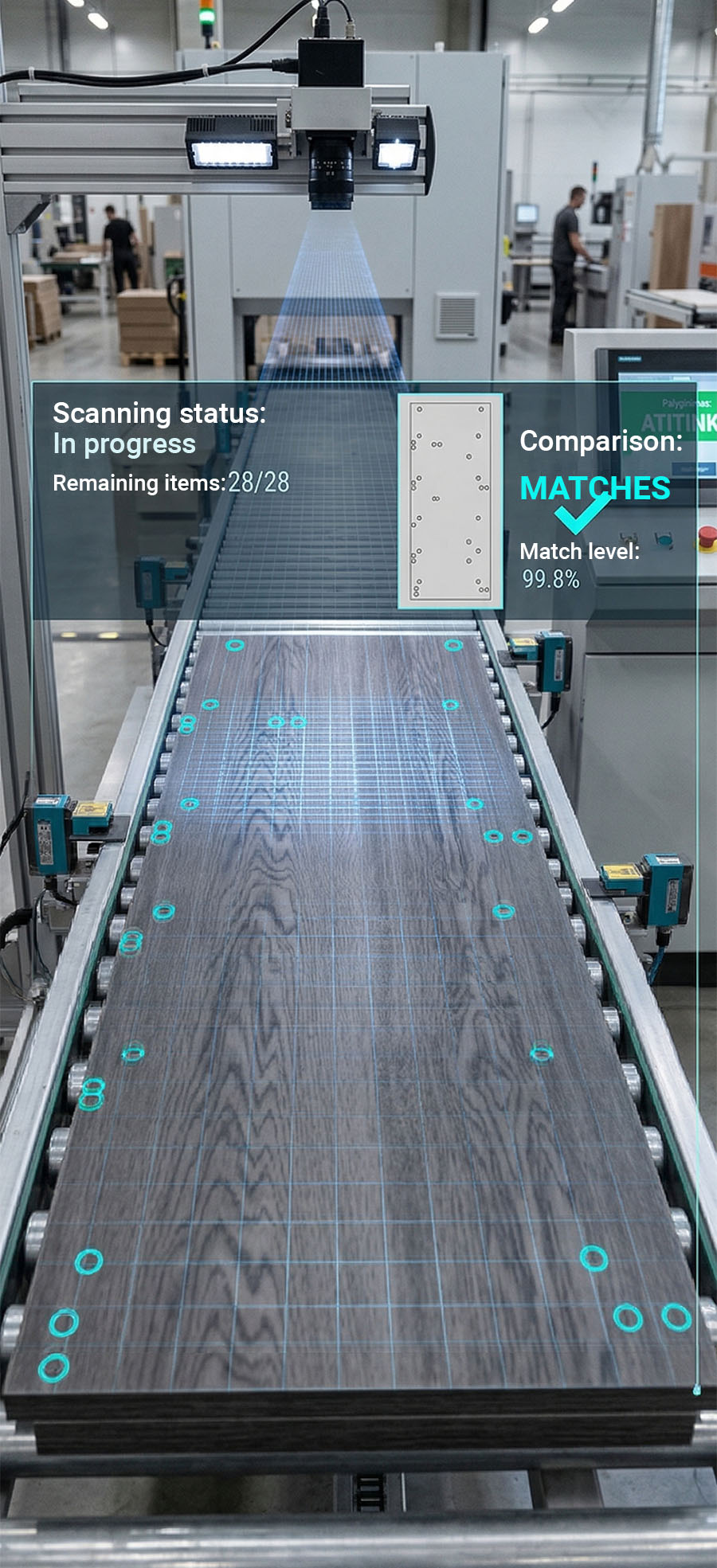
Computer Vision in Action
The system precisely locates every drilled hole and milling feature, comparing positions against CAD specifications to instantly flag deviations.
Built for Production-Grade Quality Assurance
Complete Production Coverage
Every single board undergoes inspection-eliminating the sampling gaps that allow defective products to reach packaging and customers.
Multi-Defect Detection
The system identifies diverse quality issues: missing holes, incorrect hole positions, broken drill damage, milling errors, lamination problems, and surface defects.
Non-Disruptive Integration
Computer vision inspection operates at production speed, integrating into existing conveyor systems without creating bottlenecks or requiring line modifications.
Digital Specification Matching
Direct comparison with CAD models ensures inspection accuracy matches design intent-not approximations or manual measurements.
Operator-Friendly Alerts
Clear notifications guide operators to specific issues, enabling rapid response and preventing defective boards from progressing through production.
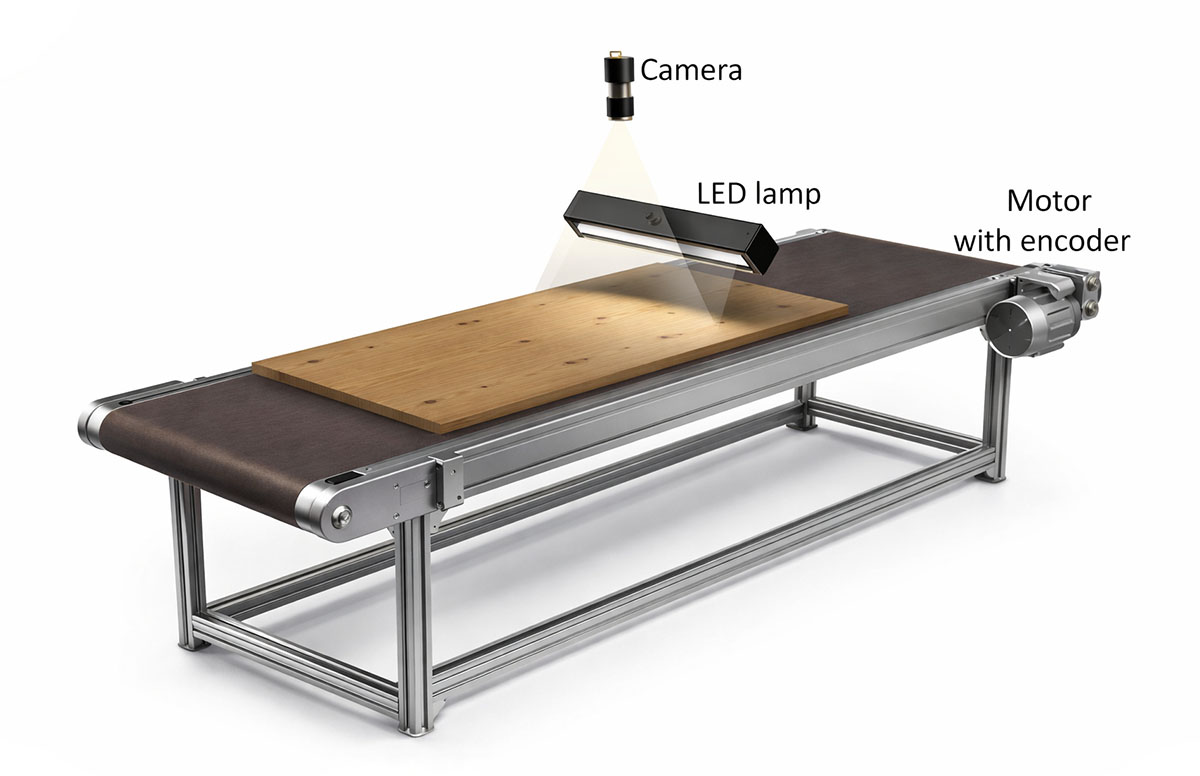
Production Line Setup
Industrial cameras and precision lighting integrated into the conveyor system enable high-resolution capture of every board surface at full production speed.
Measurable Impact on Manufacturing Operations
Near-Zero Defect Rates
Comprehensive inspection reduces defective products in packaging to virtually zero-eliminating costly returns, replacements, and customer complaints.
Workforce Optimization
Automated inspection frees workers from monotonous visual checking, allowing reallocation to higher-value tasks that benefit from human judgment and skill.
Rapid ROI Achievement
Modern computer vision models deliver increasing accuracy at decreasing implementation costs-accelerating return on investment for quality control automation.
Production Intelligence
Inspection data reveals patterns in defect occurrence, enabling proactive maintenance scheduling and process optimization before problems escalate.
Customer Confidence
Products that arrive complete and correct build brand trust. Eliminating assembly failures transforms customer experience from frustration to satisfaction.
Cost Elimination
Catching defects at production costs a fraction of discovering them through returns. Prevention replaces remediation as the quality control strategy.
Continuous Improvement
Every inspection generates data. Pattern analysis identifies root causes-whether specific machines, shifts, or material batches correlate with quality issues.
Scalable Coverage
As production volumes grow, computer vision inspection scales without proportional increases in quality control staff-maintaining complete coverage regardless of throughput.
Quality Assurance That Scales with Production
For furniture manufacturers competing on quality and reliability, manual inspection cannot keep pace with modern production demands. Computer vision inspection delivers:
Customer Confidence
Products that arrive complete and correct build brand trust. Eliminating assembly failures transforms customer experience from frustration to satisfaction.
Cost Elimination
Catching defects at production costs a fraction of discovering them through returns. Prevention replaces remediation as the quality control strategy.
Continuous Improvement
Every inspection generates data. Pattern analysis identifies root causes-whether specific machines, shifts, or material batches correlate with quality issues.
Scalable Coverage
As production volumes grow, computer vision inspection scales without proportional increases in quality control staff-maintaining complete coverage regardless of throughput.