
Broswarm AI Object Detection for Landmine Detection Drones
AI Object Detection for Autonomous Landmine Detection Drones
Agmis together with Broswarm developed the revolutionary drone platform. We took leadership in developing advanced AI object detection algorithms, enabling autonomous identification of buried and surface-level explosive threats across multiple terrain types.
Broswarm – Revolutionizing Underground Object Detection
Broswarm is an innovative Lithuanian defense technology company founded to tackle the global landmine crisis by replacing outdated sensing technologies such as metal detectors, magnetometers and conventional ground-penetrating radars with a groundbreaking, fully autonomous solution. Their platform combines the world's lightest synthetic aperture radar (X-SAR™) with autonomous drone technology to detect buried objects - including both metallic and plastic-cased threats - at depths up to 0.5 meters below surface.
The company has earned significant recognition for their groundbreaking technology: winning first place in the NATO Innovation Challenge for mine clearance technology, securing €800,000 in funding for landmine detection development, and receiving the "Recognition of the Year" award from the Lithuanian Defence and Security Industry Association - of which Broswarm is a proud member.

Outdated Detection Technology Costs Lives
Global Landmine Crisis
Millions of landmines and unexploded ordnances remain buried worldwide, causing thousands of casualties annually and rendering vast areas of land unusable for communities, agriculture, and development.
Limitations of Traditional Methods
Conventional detection relies on handheld metal detectors and ground-penetrating radars - technologies that are slow, dangerous for operators, and ineffective against modern plastic-cased explosives.
Complex Data Interpretation
Radar systems generate massive volumes of multidimensional data. Without intelligent analysis, human operators struggle to interpret subsurface imagery and distinguish threats from harmless underground objects.
Multi-Material Detection Gap
Traditional metal detectors cannot identify plastic, rubber, or composite materials increasingly used in modern explosive devices - creating dangerous blind spots in clearance operations.
Intelligent AI Object Detection for Subsurface and Surface Threats
Radar-Based Underground Detection: Our computer vision models analyze 3D holographic data from Broswarm's X-SAR™ radar, identifying buried objects through amplitude and phase signal processing. The AI object detection system recognizes threats made from metal, plastic, rubber, and other man-made materials at subsurface depths.
Multi-Terrain Adaptability: AI object detection models were trained across four distinct terrain types - sand, soil, vegetation, and gravel - ensuring reliable performance across the diverse ground conditions encountered in real-world clearance operations.
Optical Surface Detection: Complementing underground scanning, our camera-based AI object detection identifies visible and partially visible threats from drone imagery, enabling comprehensive coverage of both buried and surface-level explosives.
3D Spatial Reconstruction: Detection algorithms process volumetric radar data layer by layer, then merge findings into unified 3D object identification - providing precise location coordinates for each detected threat.
Synthetic Data Augmentation: To maximize detection accuracy with limited real-world explosive samples, we developed sophisticated data augmentation techniques that expand training datasets while maintaining model reliability.
Multi-Sensor Fusion: The combined radar and optical AI object detection approach significantly increases threat identification probability - surface scans catch visible items while subsurface analysis identifies buried dangers.
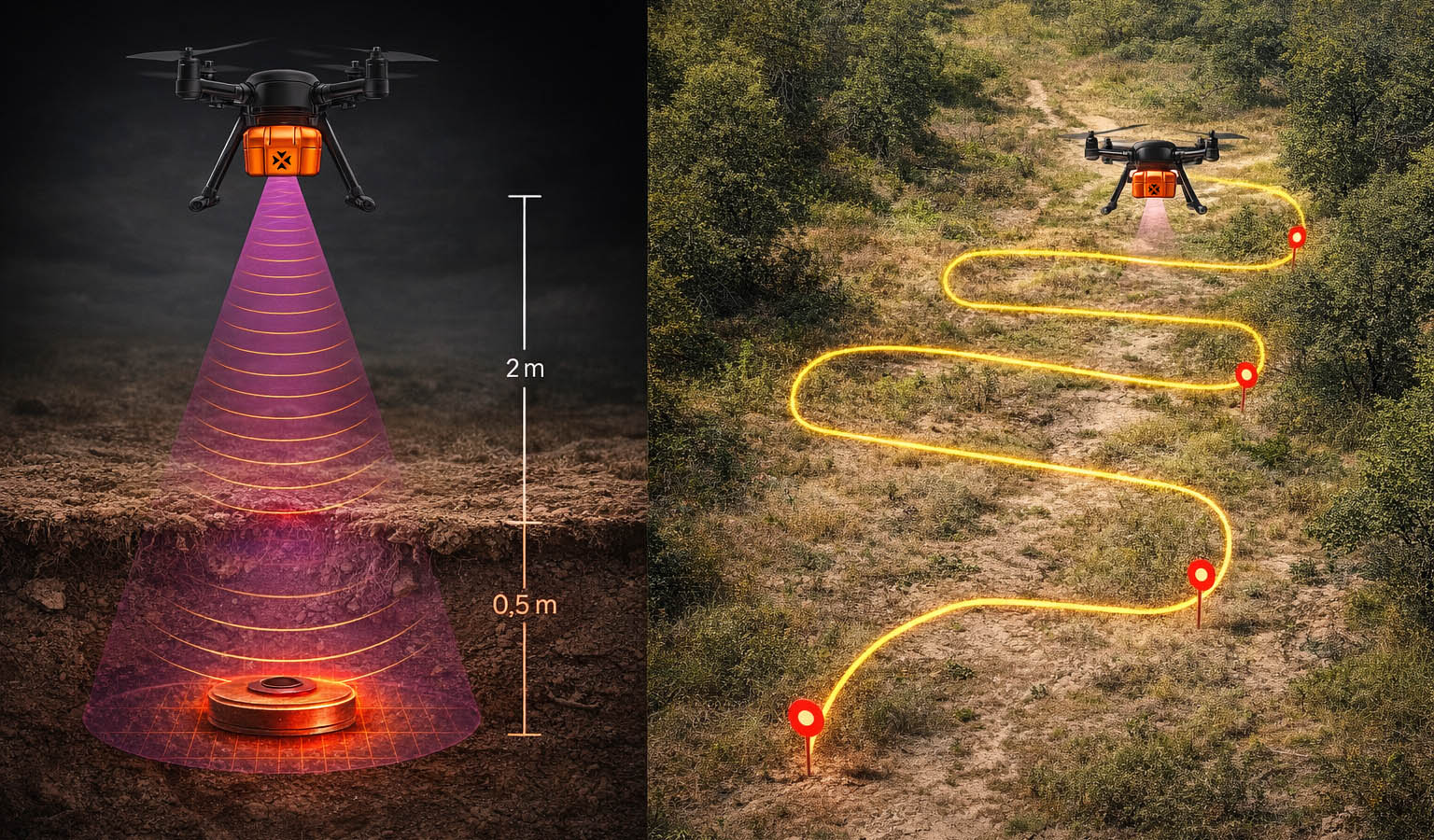
AI Object Detection in Action
Broswarm's drone platform uses X-SAR™ radar to penetrate the ground and detect buried landmines, while optical sensors identify surface-level threats across diverse terrain.
From Raw Sensor Data to Confirmed Threat Detection
Data Processing Pipeline
Radar signals are transformed into 3D holographic data blocks containing amplitude and phase information. Our AI algorithms analyze cross-sectional slices, identifying threat signatures before merging detections into unified 3D object coordinates.
Deep Learning Architecture
Advanced neural networks trained on annotated datasets distinguish between genuine threats and harmless subsurface objects like rocks, roots, and debris - reducing false positives that slow clearance operations.
Segmentation-Based Annotation
Precise polygon annotations enable the AI to learn exact object boundaries rather than approximate bounding boxes, improving detection accuracy for partially obscured or irregularly shaped threats.
Continuous Model Refinement
Detection models improve through expanded datasets incorporating diverse terrain conditions, object types, and environmental variables - building toward ever-higher accuracy rates.
Proven Detection Performance Across Environments
High-Accuracy 3D Detection
AI object detection achieves exceptional accuracy in identifying buried objects at the three-dimensional level - merging layer-by-layer analysis into confirmed threat locations.
High Soil Detection Accuracy
In soil environments, the system reached its highest detection rates - demonstrating exceptional performance in one of the most common terrain types for landmine contamination.
Multi-Material Recognition
The AI successfully identifies objects made from metal, plastic, rubber, and composite materials - closing the critical detection gap that renders traditional metal detectors ineffective against modern threats.
Cross-Terrain Reliability
Consistent performance across sand, soil, vegetation, and gravel environments proves the system's readiness for diverse real-world deployment conditions.
Autonomous Operation
Drone-mounted detection eliminates the need for human operators in dangerous proximity to potential explosives, fundamentally improving safety during survey and clearance missions.
Environmental Adaptability
Optical detection successfully identifies threats across varied conditions including snow-covered terrain - extending operational capability to challenging environments.
Scalable Coverage
Aerial deployment enables rapid scanning of large contaminated areas that would require weeks or months using traditional handheld methods.
Technology in Service of Global Safety
Each year, landmines and unexploded ordnance claim thousands of lives and prevent communities from safely accessing their land. This AI object detection partnership delivers transformative value through:
Humanitarian Impact
Faster, safer detection accelerates land clearance - returning territory to communities, enabling agricultural use, and preventing civilian casualties in post-conflict regions.
Operator Safety
Autonomous drone-based detection removes humans from direct proximity to explosive threats, fundamentally changing the risk profile of demining operations.
Detection Capability Leap
AI object detection identifies threats that traditional methods miss - particularly plastic-cased devices invisible to metal detectors - closing dangerous gaps in current clearance technology.
Scalable Deployment
The combination of aerial platforms and intelligent detection enables coverage rates impossible with ground-based manual methods, addressing the scale of global landmine contamination.