Personalized medical implants require precision at every step – but manual processing has limited how many patients can access them. A new approach using computer vision in healthcare is helping manufacturers transform what once took hours into seconds, unlocking scalability without sacrificing accuracy.
The Processing Bottleneck Limiting Personalized Medicine
Patient-specific orthopedic implants represent one of healthcare’s most promising frontiers. Unlike off-the-shelf devices, these implants are designed to match each patient’s unique anatomy, improving surgical outcomes and accelerating recovery.
But there’s a constraint that has limited how many patients can benefit: the time-intensive process of creating them.
Before a personalized implant can be manufactured, engineers must reconstruct detailed 3D anatomical models from CT scan data. This involves cleaning images contaminated by metal artifacts, identifying anatomical landmarks, and marking clinical reference points with precision. For a skilled specialist, this process often consumes a significant portion of the workday for a single case.
Hours of focused work may sound manageable for one patient. But for manufacturers aiming to serve thousands of patients annually, this processing time creates a fundamental bottleneck. Scaling production means scaling specialized labor – a resource that’s both expensive and increasingly difficult to find.
This is exactly the challenge that computer vision in healthcare was designed to address.
The Challenge Medical Device Manufacturers Face
For orthopedic implant manufacturers, the path from CT scan to finished device involves several labor-intensive steps that have traditionally resisted automation.
Metal artifact contamination complicates every case. CT images used for implant development frequently contain significant noise from existing metal hardware in the patient’s body. This contamination obscures anatomical landmarks and makes accurate reconstruction difficult, requiring specialists to painstakingly clean each image before analysis can begin.
Manual processing demands scarce expertise. The engineers who perform this work need deep knowledge of both medical imaging and anatomical structures. Training takes years, and even experienced specialists can only process a limited number of cases per day. When a single case requires hours of focused attention, throughput is inherently constrained.
Consistency risks compound with volume. Manual reconstruction, no matter how skilled the engineer, carries inherent variability. Human fatigue affects accuracy. Complex pathological cases introduce opportunities for error. And when implant precision directly affects patient outcomes, these risks carry serious consequences.
Scalability hits a ceiling. Manufacturers who want to expand production face a difficult choice: hire more specialists (expensive and slow) or accept that growth will be limited by processing capacity. Neither option supports the broader goal of expanding patient access to personalized devices.
These challenges aren’t unique to any single company – they reflect structural constraints that have limited the entire patient-specific implant industry.
What Is Computer Vision in Healthcare – And How Does It Apply Here?
Computer vision in healthcare refers to AI systems that can analyze medical images and extract clinically relevant information automatically. Rather than requiring human specialists to manually review and process each scan, computer vision models can identify patterns, detect features, and generate outputs at speeds impossible for human operators.
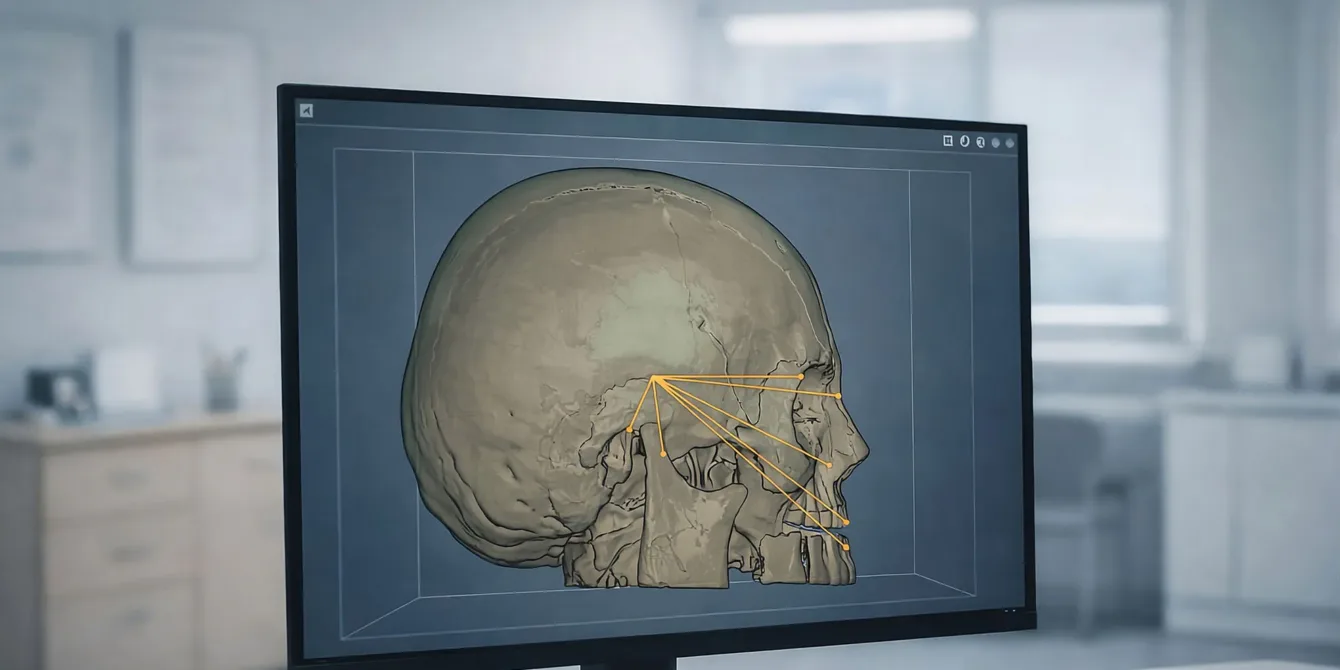
In the context of medical device manufacturing, computer vision enables automated processing of the CT scan data that feeds implant production. The technology handles tasks that previously required hours of specialist attention: cleaning artifact-contaminated images, identifying anatomical structures, marking reference points, and generating 3D models ready for implant design.
The process works in stages. First, medical imaging automation tools preprocess raw CT data, handling the noise and artifacts that make manual processing so time-consuming. Next, AI models trained on thousands of cases identify anatomical landmarks with precision matching or exceeding human specialists. Finally, the system generates complete 3D reconstructions that integrate directly into implant design workflows.
This shift from manual to automated processing represents more than incremental improvement. It fundamentally changes what’s possible in AI pre-surgical planning – transforming a three-hour bottleneck into a sub-minute operation.
Across healthcare more broadly, computer vision already supports medical imaging analysis, diagnostics, and patient monitoring – reading X-rays, MRIs, and CT scans with deep learning models trained on thousands of cases. The same infrastructure that runs in a clinic also runs on a factory floor; see our overview of computer vision applications across industries.
From Theory to Results: Computer Vision in Practice
When Ortho Baltic, one of Europe’s largest orthopedic device manufacturers, sought to overcome their processing constraints, they partnered with us to develop an AI-powered solution built on computer vision in healthcare.
Ortho Baltic’s situation reflected the industry-wide challenges. Their workflow relied on qualified engineers manually reconstructing personalized 3D anatomical models from CT images – a process demanding extensive time, specialized expertise, and meticulous attention to detail. With each case requiring approximately three hours of processing, their capacity to serve patients was fundamentally limited by available specialist hours.
The company didn’t want incremental improvement. They wanted transformation.
The approach: we developed a machine learning model capable of automating the entire 3D model reconstruction pipeline. This included CT scan processing to remove metal artifacts, automated identification of anatomical landmarks and clinical reference points, and generation of precision 3D models ready for implant customization.
Working with real medical data – much of it featuring complex pathologies – required substantial preprocessing and deep domain expertise. Our team’s medical knowledge proved essential in preparing this data for model training and ensuring the resulting system could handle the variability inherent in real-world cases.
The results exceeded expectations.
Processing time dropped from three hours to 45-60 seconds per case – a 180x improvement. What once consumed an entire morning of specialist time now completes in under a minute.
The AI model matched and in many cases exceeded human accuracy. Rather than introducing new risks, medical imaging automation actually improved consistency by eliminating the variability that comes with human fatigue and the complexity of pathological cases.
Scalability constraints disappeared. Automated processing removed the critical bottleneck that had limited case volumes, enabling Ortho Baltic to handle significantly higher throughput without proportional staffing increases.
The solution integrates directly into Ortho Baltic’s existing “Medical Implants Customization Engine” (MICE) software, enabling seamless AI pre-surgical planning workflows without disrupting established processes.
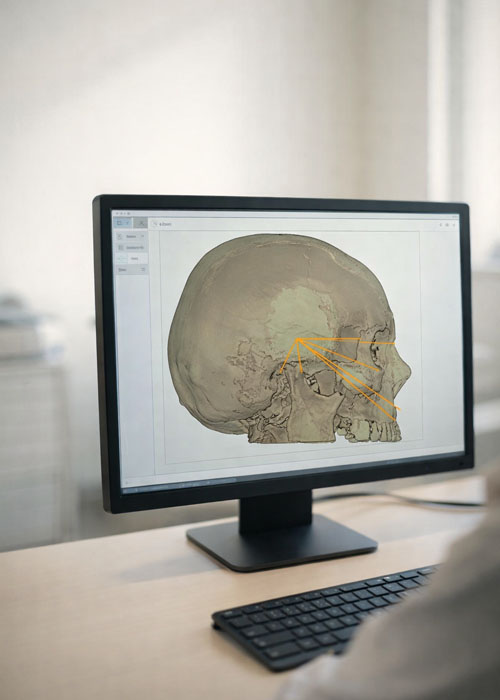

See how Agmis built an AI-powered pre-surgical planning solution for Europe's leading orthopedic implant manufacturer, automating 3D model reconstruction from CT scans with precision matching human specialists.
Why the Timing Matters for Healthcare Manufacturing
Several converging factors are driving increased interest in computer vision in healthcare among medical device manufacturers.
Demand for patient-specific devices continues growing. As surgical techniques advance and outcomes data accumulates, more procedures are moving toward personalized implants. Manufacturers who can’t scale production risk losing market position to competitors who’ve invested in automation.
Skilled labor constraints are intensifying. The specialists who perform manual CT processing require years of training. With healthcare facing broader workforce challenges, relying on manual processes creates vulnerability. AI in healthcare offers a path to maintain quality while reducing dependence on scarce human expertise.
Industry 4.0 is reaching healthcare manufacturing. The same automation and AI technologies transforming other manufacturing sectors are now mature enough for medical applications. Computer vision in healthcare has moved from experimental to production-ready, with proven results in real clinical workflows – see our roundup of computer vision projects running in production today.
Time-to-patient affects outcomes. For patients waiting for implants, processing delays translate to extended pain and limited mobility. Reducing the time from CT scan to finished device isn’t just an operational improvement – it’s a patient care improvement.
Regulatory frameworks are adapting. As AI in healthcare demonstrates consistent, validated results, regulatory pathways for automated medical processes are becoming clearer. Manufacturers who build expertise now will be better positioned as these frameworks mature.
How Computer Vision in Healthcare Addresses Core Manufacturing Challenges
For medical device leaders evaluating this technology, the value proposition centers on four interconnected benefits.
Processing speed unlocks volume. When each case requires hours of specialist time, annual capacity is mathematically constrained. Reducing processing to under a minute means the same team can handle dramatically more cases. The 180x speed improvement we achieved at Ortho Baltic demonstrates how computer vision in healthcare can fundamentally change throughput economics.
Consistency eliminates variability. Every automated 3D model reconstruction follows the same precise workflow. Unlike manual processing, where quality can vary based on specialist fatigue or case complexity, AI pre-surgical planning delivers reproducible results across all cases. This consistency matters enormously when implant precision directly affects patient outcomes.
Scalability decouples from headcount. Traditional scaling required proportional increases in specialist staff – expensive, slow, and dependent on a limited talent pool. Medical imaging automation breaks this link, enabling manufacturers to grow production without equivalent workforce expansion. The infrastructure investment serves increasing volumes without recurring labor costs.
Foundation for mass personalization. The combination of speed, consistency, and scalability positions manufacturers for a future where patient-specific devices can be produced at scale. Computer vision in healthcare represents a step toward making personalized implants accessible to far more patients than current manual processes can serve.
Implementation Considerations for Healthcare Manufacturers
Manufacturers evaluating computer vision for their operations should consider several practical factors.
Medical data complexity requires domain expertise. Real CT data frequently includes pathologies, artifacts, and edge cases that challenge AI models. Successful implementations require teams who understand both machine learning and medical imaging – not just software engineers, but partners with genuine healthcare domain knowledge. Our team’s medical expertise proved essential in preprocessing data and training models that could handle real-world variability.
Integration with existing workflows matters. The most effective solutions connect directly to established systems rather than creating parallel processes. At Ortho Baltic, the AI model output integrates seamlessly into their existing MICE software, enabling adoption without disrupting proven workflows.
Validation must meet healthcare standards. Unlike consumer applications, AI in healthcare requires rigorous validation demonstrating that automated outputs match or exceed human accuracy. This validation work should be built into implementation timelines and budgets.
Change management affects adoption. Even dramatic efficiency gains require workforce adjustment. Specialists who previously spent hours on manual processing need new roles focused on higher-value work – oversight, exception handling, and quality verification rather than routine reconstruction.
Beyond Implant Planning: Extended Applications
The same computer vision infrastructure that powers automated CT scan processing can address additional challenges in healthcare manufacturing.
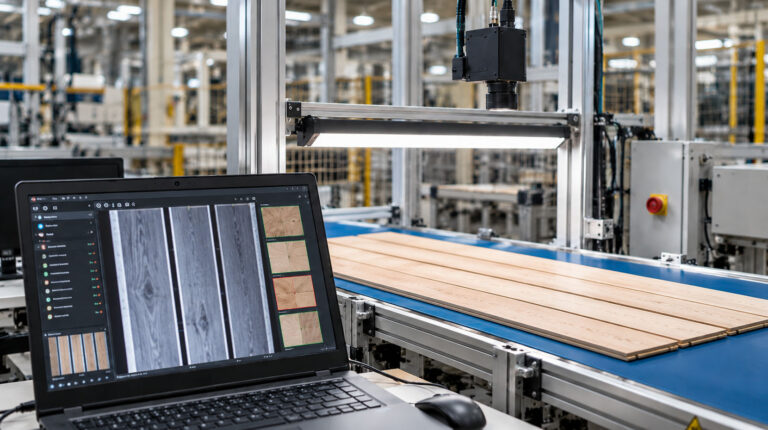
AI quality control uses computer vision to identify defects in manufactured devices with consistency impossible for human inspectors reviewing thousands of units. Dimensional verification ensures finished implants match design specifications within required tolerances. Production monitoring tracks manufacturing processes in real-time, identifying anomalies before they affect product quality.
For manufacturers investing in computer vision healthcare, pre-surgical planning often serves as the entry point because the ROI is directly measurable – three hours reduced to sixty seconds translates clearly to cost savings and capacity gains. But the technology investment can extend across multiple manufacturing and quality processes over time.
The underlying capability – AI systems that can analyze complex medical data and extract actionable information – applies broadly across healthcare manufacturing challenges.
What This Shift Signals for Healthcare Manufacturing
The transformation at Ortho Baltic reflects a broader shift in how medical device manufacturers approach production. Manual processes that once seemed irreducibly complex are proving amenable to automation when computer vision is applied thoughtfully.
The implications extend beyond operational efficiency. Processing time dropping from hours to seconds expands patient access to personalized implants. Consistency gains translate to improved surgical outcomes. Scalability without proportional workforce expansion makes the economics of personalized medicine finally viable.
AI in healthcare isn’t replacing the expertise of medical specialists – it’s amplifying what that expertise can accomplish. Engineers who once spent three hours processing a single case can now oversee dozens, focusing their knowledge on exceptions and quality verification rather than routine reconstruction.
For healthcare manufacturing leaders, the question is no longer whether computer vision can transform operations. The results from early adopters demonstrate that it can. The question is how quickly organizations can capture these gains – in efficiency, in quality, and ultimately in expanded patient access to personalized care.