
Technology moves fast. Some companies keep up; others fall behind. After working with dozens of organizations across logistics, manufacturing, retail, and professional services, we’ve noticed a pattern: the difference between thriving and struggling rarely comes down to budget or industry. It comes down to Digital Maturity – and more specifically, understanding which stage your organization currently occupies.
Digital maturity isn’t about having the newest software or the flashiest website. It’s about how effectively your organization uses technology to solve real problems, make smarter decisions, and adapt to constant market changes. It’s the engine that powers a successful digital transformation, ensuring that investments in technology translate into real-world value and sustainable digital growth.
This article serves as your guide. We will break down the essential stages of the digital journey, helping you pinpoint where your business stands and, more importantly, how to chart a clear path forward.
What Digital Maturity Actually Means
Digital Maturity measures how effectively your organization uses digital technologies, processes, and people to achieve its business goals. It’s not a simple checklist of tools you own; it’s a holistic reflection of how your strategy, operations, and digital culture work in harmony.
A company with a massive ERP system can be less digitally mature than a small business running on well-integrated cloud tools. The difference lies in integration and strategic application. True digital maturity reveals itself in your ability to respond to shifting Customer Demands. When a support ticket comes in, does your team scramble through three disconnected systems to find the order history? Or does a unified view of the customer surface automatically, enabling a seamless Customer experience?
These scenarios define the gap between simply using digital tools and being digitally mature. It’s the difference between reacting to problems and proactively shaping outcomes, forming the foundation upon which every successful digital transformation is built.
The 4 Digital Maturity Stages Explained
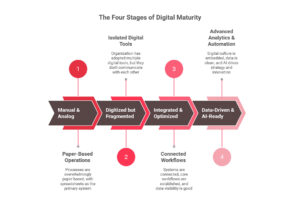
The four stages of digital maturity, from manual processes to a fully optimized and innovative organization.
Every business sits somewhere on a spectrum of digital development. Understanding this spectrum through a Digital Maturity Model is the first step toward meaningful progress. This framework helps you honestly assess your current digital capabilities, identify critical weaknesses, and create a realistic roadmap for advancement. Be honest with yourself about where you are – that clarity is the catalyst for real change.
Digital Maturity Stage 1: Manual & Analog
What it looks like: Processes are overwhelmingly paper-based, with spreadsheets serving as the primary “system.” Communication relies heavily on phone calls and emails, and critical knowledge is often locked away in the heads of a few key employees. There is no formal digital strategy, and the digital infrastructure is either non-existent or completely ad-hoc.
Example: A regional logistics company tracks deliveries using printed manifests. When a customer calls about a shipment, staff has to physically locate the paper, then call the driver. The average response time is 45 minutes, leading to constant customer complaints and low customer satisfaction. Scaling the business meant hiring more people to manage more paper – a losing equation that stifled growth.
The hidden costs:
- Errors compound: One wrong entry cascades through the entire manual process.
- Knowledge walks out the door: When key employees leave, their operational knowledge goes with them.
- Growth creates chaos: Increased business volume overwhelms manual systems instead of creating opportunity.
- Decisions are based on gut feelings: A lack of accessible data means strategic choices are guesses, not informed calculations.
Stage 2: Digitized but Fragmented
What it looks like: The organization has adopted multiple digital tools, but they don’t communicate with each other. A CRM here, an inventory system there, and an accounting platform somewhere else. Data lives in isolated silos, forcing employees to act as human “bridges,” manually copying and pasting information between systems to complete a single workflow. A nascent digital strategy may exist, but it’s rarely cohesive.
Example: A mid-sized retailer had invested significantly in technology – an e-commerce platform, a point-of-sale system, and warehouse management software. Individually, they were good tools. But because they weren’t integrated, the customer experience was fragmented. Customers would order products shown as “in stock” online that were actually sold out in the store. The warehouse held inventory the website didn’t reflect. Staff spent hours each day trying to reconcile the systems, creating more work instead of improving efficiency and hampering customer engagement.
The hidden costs:
- Duplicated effort: Teams across departments perform the same data entry tasks.
- No single source of truth: Conflicting data between systems leads to confusion and poor decision-making.
- Poor customer visibility: It’s impossible to get a complete view of the customer journey.
- Low digital literacy: Employees learn to operate one tool but don’t understand how their work impacts the broader digital ecosystem.
Stage 3: Integrated & Optimized
What it looks like: Systems are connected, core workflows are established, and there is good data visibility across the organization. The foundational digital infrastructure is solid. However, many processes were designed for yesterday’s needs and optimization is still a manual, reactive effort. The business has strong digital capabilities but hasn’t yet leveraged them for proactive, strategic advantage.
Example: A manufacturing client had implemented an ERP and integrated it well with their core systems. Data flowed, reports were generated automatically, and the Customer experience was efficient. But production scheduling was still a manual bottleneck. A skilled planner spent days each week building schedules in spreadsheets before entering them into the ERP. When unexpected market changes occurred, like a demand spike or a machine failure, re-planning the entire production schedule took hours of painstaking work. The system was integrated, but it wasn’t adaptive.
The hidden costs:
- Key processes depend on individuals: The “hero employee” who knows how to make the complex spreadsheet work becomes a single point of failure.
- Reactive operations: The business can respond to change, but it can’t anticipate it.
- Missed optimization opportunities: Without automation, the company is leaving efficiency and cost savings on the table.
- Stagnant digital growth: The focus remains on maintaining the status quo rather than pursuing innovation.
Stage 4: Data-Driven & AI-Ready
What it looks like: A robust digital culture is embedded across the organization. The digital foundation is strong, data is clean and accessible, and key workflows are automated. The business is now positioned to leverage advanced analytics, machine learning, and AI – not as isolated experiments, but as core operational tools that drive strategy and create a competitive moat. They are actively exploring and adopting emerging technologies.
Example: An e-commerce company uses machine learning to forecast demand at the individual product level. The model considers seasonality, marketing campaigns, competitor pricing, and dozens of other variables. As a result, stock waste dropped by 40% and margins improved significantly. More importantly, the buying team shifted from reactive ordering to strategic planning. They went from constantly catching up to thinking three months ahead, building one of their greatest digital strengths.
The opportunity at this stage:
- Predictive analytics: Preventing problems before they occur, from equipment maintenance to customer churn.
- Hyper-personalization: Tailoring the Customer experience at scale with dynamic recommendations and pricing.
- Strategic agility: Using data to model future scenarios and pivot faster than competitors.
- Innovation becomes the norm: A strong foundation and data-driven culture empower continuous improvement and exploration.
Why Your Current Stage Matters More Than You Think
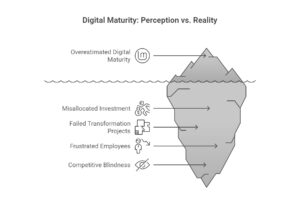
Here’s what we’ve learned from assessing digital maturity across dozens of organizations: most companies overestimate where they stand. The executive team sees the software licenses they’ve purchased and assumes a high level of maturity. Meanwhile, frontline employees are still copying data between systems and building shadow spreadsheets to get their jobs done.
This gap between perception and reality is dangerous. It leads to:
- Misallocated investment: Buying advanced AI tools when the underlying data and digital infrastructure can’t support them.
- Failed transformation projects: Attempting Stage 4 initiatives with Stage 2 capabilities. Indeed, while 63% of executives report performance increases from digital transformation, many initiatives struggle to deliver lasting value.
- Frustrated employees: Staff who see the daily problems but aren’t empowered to fix them become disengaged.
- Competitive blindness: Not realizing how far ahead the competition has moved until it’s too late.
Achieving and sustaining change is a significant challenge; only 16% of organizations successfully improve performance and maintain those changes long-term. Understanding your true digital maturity stage is the critical first step to joining that successful minority.
But to identify your stage with confidence, you need a structured approach. Read our guide on how to measure digital maturity accurately before moving on to the assessment.
How to Assess Your Digital Maturity
You can’t improve what you don’t measure. A true assessment goes beyond a simple technology inventory and evaluates how different elements of your business work together. A formal Digital Maturity Index or model provides a structured way to get an objective view of your organization.
A proper assessment requires looking at six interconnected areas:
- Digital Strategy: Are your technology investments directly aligned with your overarching business goals, or is IT operating in a silo? Are your digital strategies documented, understood, and actively managed?
- Process & Operations: How much manual work still exists in your core workflows? Where are the bottlenecks that slow down operations and frustrate customers?
- Technology & Infrastructure: Are your systems integrated, scalable, and secure? Is your digital infrastructure an enabler of growth or a barrier to it?
- Data & Analytics: Is data accessible, accurate, and actually used for decision-making? Do you have the capability to move from historical reporting to predictive insights?
- People & Culture: Is your digital culture one that embraces change, or is there resistance? Is change management a formal practice? Are employees empowered by technology or frustrated by it?
- Customer Focus: How deeply do you understand the customer journey? Do you actively measure and work to improve customer satisfaction and customer engagement through digital channels?
What Happens After You Know Your Stage
Knowing your stage is enlightening, but it’s only useful if it leads to action. Once you have an honest baseline, the next move on your digital journey becomes clear. This is where a strategic roadmap, or a “Digital Journey Planner,” becomes invaluable.
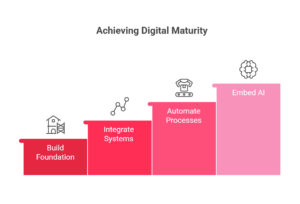
Here’s our honest advice based on stage:
- If you’re at Stage 1: Don’t try to leapfrog to AI. Your immediate priority is building a foundation. Focus on digitizing your most painful and inefficient manual processes first.
- If you’re at Stage 2: Integration is your number one goal. Before buying any new tools, focus on connecting the systems you already have. Map your data flows to eliminate manual bridges and create a single source of truth.
- If you’re at Stage 3: Look for high-impact automation opportunities within your most complex, time-consuming processes. This is the time to explore custom solutions where off-the-shelf tools fall short of your specific operational needs.
- If you’re at Stage 4: Be strategic about AI and emerging technologies. Identify specific business cases with a clear ROI. The goal is to embed these advanced digital capabilities into core operations to drive a sustainable competitive advantage. After all, companies with high Digital Maturity are two to three times more likely to be focused on innovation and growth.
How Agmis Helps Companies Move Forward
We specialize in helping businesses advance through the digital maturity stages – not with generic consulting, but with practical, hands-on implementation. We partner with you to build the specific digital capabilities you need to get to the next level.
What that looks like:
- Digital Maturity Assessments that provide an honest baseline and an actionable roadmap tailored to your goals.
- System Integration that connects your existing tools, breaks down data silos, and eliminates costly manual workarounds.
- Custom Software Development for unique processes where off-the-shelf solutions can’t deliver the required functionality or efficiency.
- AI & Machine Learning Implementation across computer vision, predictive analytics, and process optimization to unlock new levels of performance.
We’ve helped companies reduce customer response times from hours to seconds. Manufacturers we partnered with cut complex scheduling time by 80%. Retailers finally achieved the single source of truth needed to deliver a world-class customer experience.
Your Next Step
The worst thing you can do is nothing. Digital maturity isn’t a static destination; it’s an ongoing process. Your competitors are investing, customer expectations are constantly rising, and the gap between digitally mature companies and those that lag behind grows wider every year.
The good news? You don’t need to transform everything overnight. You simply need to know where you stand, decide where you want to go, and take the first, deliberate step.
Take our free digital maturity self-assessment. It takes less than 5 minutes and gives you immediate insight into your organization’s strengths and weaknesses.
Your digital journey starts with knowing where you are. Let’s find out together.