Launching a new software product is thrilling – but excitement can often lead teams to skip the crucial first step: structured discovery. That shortcut is costly.
Nearly 70% of software projects worldwide fail to meet customer expectations. Moderate to large IT projects overshoot budgets by 45% and deliver just 44% of intended value. The reason? Poor planning, weak alignment, and undefined scope from the start.
The Software Discovery Phase prevents these pitfalls. It’s a structured, insight-driven approach that turns ideas into validated, development-ready strategies – ensuring your team builds the right product, the right way.
At Agmis, we’ve spent more than 17 years refining our discovery process across a wide range of industries – from logistics, retail, and industrial operations to FinTech, MedTech, and other complex, innovation-driven sectors. Our workflows are governed by ISO 27001-certified security standards, assuring enterprise-grade quality, consistency, and data protection.
What Is the Software Discovery Phase and Why Is It Your Project Blueprint?
The Software Discovery Phase – also known as a Discovery Workshop – is the first and most critical stage of software development. It’s where vision, validation, and planning converge.
This collaborative process defines the project’s goals, requirements, user needs, technical direction, and success metrics before coding begins. In short, it’s the blueprint that ensures every stakeholder moves forward with clarity and confidence.
Why the Discovery Phase Is Crucial: Top Benefits for Your Project
The discovery phase isn’t bureaucracy – it’s a strategic accelerator for smarter, safer, and more profitable product delivery.
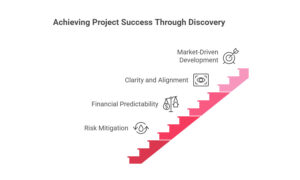
1. Risk Mitigation and Financial Predictability
- Identifies risks early: Maps potential blockers before they escalate.
- Reduces rework: Up to 60% of development costs stem from fixing avoidable mistakes; discovery eliminates most of them.
- Improves cost accuracy: Provides data-driven budget and time estimates to keep development predictable.
2. Clarity, Alignment, and Focus
- Sets measurable goals: Defines KPIs and success criteria from day one.
- Aligns all stakeholders: Unites business and tech teams around one validated vision.
- Prevents scope creep: Establishes clear milestones, deliverables, and responsibilities.
3. Market-Driven Product Development
- Ensures product-market fit: Validates that your concept solves a verified problem.
- Enhances UX: Empowers designers with real user insights.
- Defines competitive edge: Informs strategy through gap and market analysis.
The Agmis Discovery Framework: Our Three Pillars for Predictable Development
We built the Agmis discovery workshop framework to guarantee technical, strategic, and financial predictability across every project.
1. Technical Feasibility Deep Dive
We assess current systems, evaluate infrastructure, and define the optimal technology stack. This stage uncovers integration challenges and scalability constraints early – before they affect timelines or cost.
2. User-Centric Business Validation
Our analysts validate your core hypotheses through user research, data analysis, and competitive benchmarking. This ensures your MVP is grounded in real market demand, not assumptions.
3. Fixed-Scope, Fixed-Cost Deliverables
Each discovery engagement produces concrete outputs – including a Software Requirements Specification (SRS), validated scope, and fixed-price development estimate – giving you budget certainty and stakeholder alignment before build-out.
The Discovery Phase in Action: Steps, Key Deliverables, and Team Setup
A successful discovery process is cross-functional, combining business strategy, technical expertise, and UX thinking.
Key Roles
- Project Manager: Oversees communication, schedules, and goal alignment.
- Business Analyst: Defines requirements, KPIs, and measurable outcomes.
- Technical Lead/Architect: Evaluates feasibility and architecture design.
- UI/UX Designer: Maps customer journeys and creates early wireframes.
- Stakeholders/Clients: Provide vision, strategy, and domain insight.
Process Overview
- Define Objectives and Scope: Establish SMART goals and business outcomes.
- Gather Requirements: Conduct interviews and workshops to identify expectations.
- Research and Validation: Perform user research, competitor analysis, and market mapping.
- Solution Design and Technical Assessment: Outline feasible architectures and tech stacks.
- Feature Prioritization and Roadmapping: Focus on MVP features for rapid delivery.
- Alignment and Approval: Present findings, timelines, and estimates for stakeholder sign-off.
Discovery Phase Deliverables: What You Get Out of Discovery
The output of discovery isn’t code – it’s a complete set of strategic and technical deliverables that eliminate uncertainty and reduce risk.
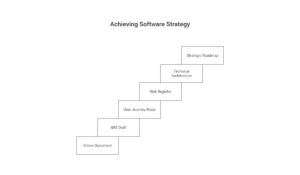
- Vision Document and Project Goals
Defines the overall vision, KPIs, monetization model, and measurable success targets.
- Software Requirements Specification (SRS) Draft
Captures all functional and non-functional requirements, aligning technical and business objectives.
- User Journey Maps and Low-Fidelity Wireframes
Visualize user flows, key touchpoints, and early UI structure to validate usability before design.
- Detailed Risk Register and Mitigation Plan
Lists potential blockers, their probability and impact, and concrete mitigation strategies.
- Technical Architecture and Stack Selection
Outlines system architecture, integrations, and technology recommendations that ensure scalability and maintainability.
- Strategic Roadmap and Precise Budget/Timeline Estimates
Presents clear milestones, cost projections, and delivery timelines for MVP and full-scale rollout.
Together, these deliverables form a comprehensive decision-making toolkit that transforms ideas into executable software strategies.
The Cost of Skipping the Discovery Phase
Teams that skip discovery often pay for it later – with misaligned expectations, architectural errors, and spiraling costs.
- Wrong Product Fit: Building features users don’t need.
- Budget Overruns: Late-stage changes and technical rework drive expenses up.
- Operational Chaos: Undefined architecture causes instability and delays.
- Stakeholder Frustration: Ambiguity leads to missed deadlines and trust issues.
- Skipping discovery doesn’t save time – it compounds risk.
Conclusion: Start with Clarity and Confidence
The Software Discovery Phase transforms uncertainty into clarity and ideas into validated, build-ready plans. It’s the foundation for every successful digital product – ensuring predictable budgets, stronger architecture, and proven market alignment.
At Agmis, we combine 17 years of software engineering expertise with ISO 27001-certified processes, guaranteeing both innovation and security.
Investing a few weeks in discovery can save months of rework – and thousands in unnecessary costs. Like a real-time GPS for your project, the discovery phase maps the fastest route, flags risks in advance, and guides your product safely to launch.
Get a free consultation on software development, process automation, or AI-powered solutions — no commitment required.
Our senior consultants will review your goals, challenges, and opportunities, and outline the most effective next steps for your business.